

Have you ever brewed a fresh pot of coffee only to find it tastes like bitter mud or weak, dirty water? Getting your morning caffeine fix should not feel like a guessing game. Fortunately, mastering how much coffee grounds per cup you need is the easiest way to guarantee a perfect brew every single time. Consequently, you can stop wasting expensive coffee beans and start enjoying barista-quality flavor in the comfort of your own kitchen.
To find out how much coffee grounds per cup you need, you should use the golden ratio of 1 to 2 tablespoons of ground coffee for every 6 ounces of water. However, the precise measurement depends heavily on your preferred brewing method, roast level, and specific cup size. By adjusting these variables, you can easily customize your coffee to match your exact taste preferences.
- The Standard Ratio: Use 1 to 2 tablespoons of ground coffee per 6-ounce cup.
- Weighing is Best: Measuring by weight (grams) is far more accurate than using spoons.
- Know Your Mug: A standard coffee maker “cup” is usually 5 to 6 ounces, not 8 ounces.
- Adjust for Roast: Dark roasts are less dense, meaning you may need to adjust your spoon measurements.
Decoding the Golden Ratio of Coffee Brewing
To understand coffee brewing, you must first understand the concept of the golden ratio. This mathematical standard represents the ideal balance of water and coffee grounds. Typically, specialty coffee associations recommend a ratio between 1:15 and 1:18.
Consequently, use 1 gram of coffee per 15 to 18 grams of water. If you prefer a stronger, more intense cup, you should lean toward the 1:15 ratio. Conversely, a lighter, more delicate cup benefits from a 1:18 ratio.
Furthermore, using a digital kitchen scale is the most accurate way to measure these ratios. Measuring by weight eliminates the inconsistencies caused by different grind sizes and bean densities. Therefore, serious coffee enthusiasts always weigh their ingredients before brewing.
However, if you do not own a scale, you can still use volumetric measurements. Understanding how much coffee grounds per cup to use in tablespoons will help you achieve a highly consistent brew. Ultimately, consistency is the secret to unlocking the best flavors from your coffee beans.
Measuring by the Spoon: Tablespoons vs. Grams
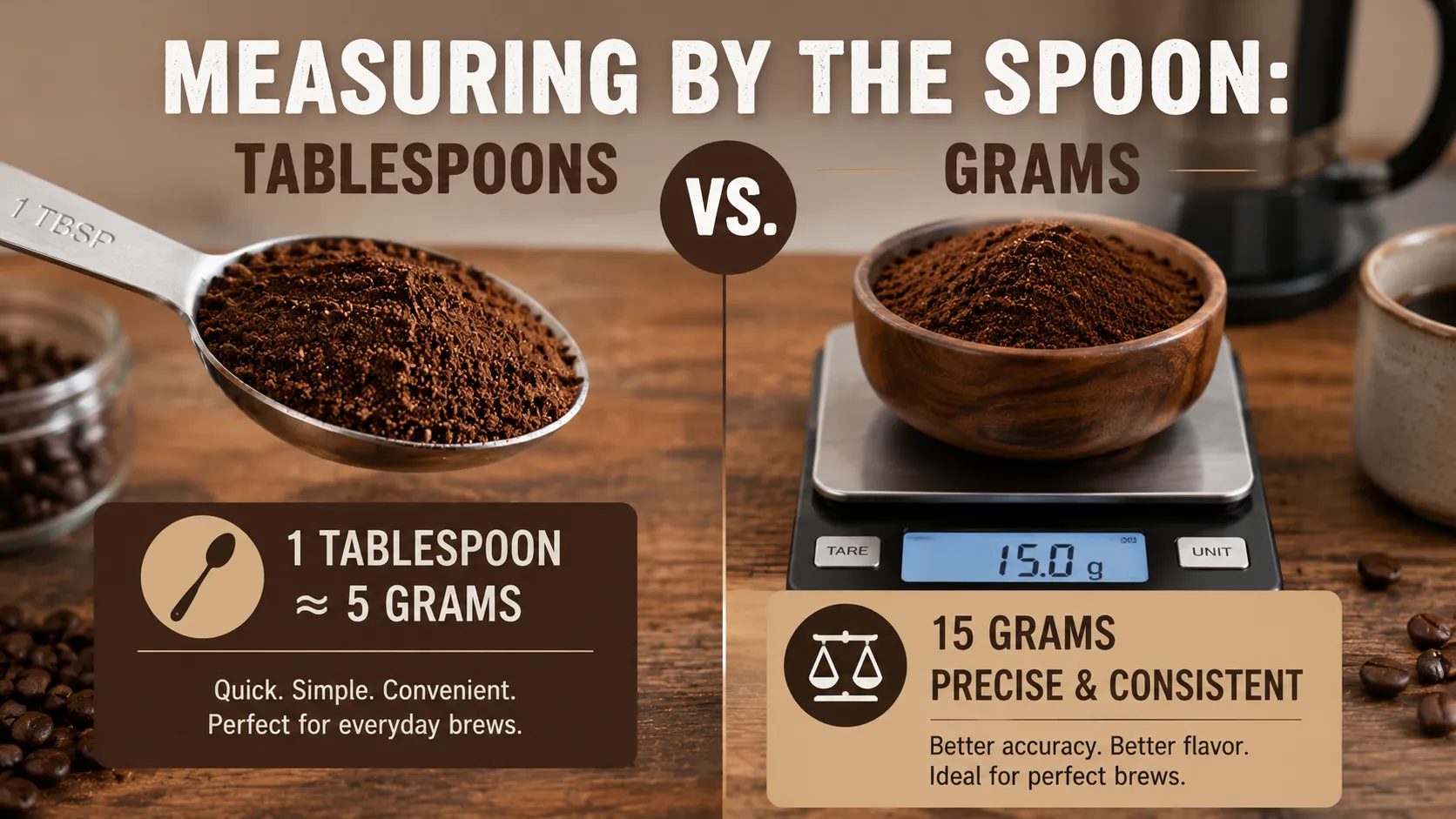
Not everyone wants to use a digital scale before they have had their morning caffeine. As a result, many people rely on standard kitchen tablespoons for convenience. A level tablespoon of ground coffee weighs approximately 5 to 7 grams.
Therefore, if you want to know how much coffee grounds per cup to use, you can estimate with spoons. Using two level tablespoons will give you about 10 to 14 grams of coffee. This amount is ideal for a standard six-ounce cup of water.
However, you must remember that different roasts have different physical densities. Dark roast beans are larger and less dense than light roast beans. Consequently, a tablespoon of dark roast weighs less than a tablespoon of light roast.
To maintain consistency, you should try to use the same scoop every single day. In addition, always level off the top of the spoon with a flat edge. Doing so ensures you do not accidentally add too much coffee to your brewer.
Moreover, you should avoid using regular eating spoons for measuring. These spoons vary widely in size and will lead to highly inconsistent results. As a result, your coffee will taste different every time you brew it.
The Crucial Difference in Cup Sizes
One of the biggest sources of confusion in coffee brewing is the definition of a “cup.” In standard cooking measurements, a cup equals eight fluid ounces. However, most coffee maker manufacturers define a cup as only five or six ounces.
Consequently, if you fill your coffee pot to the “4-cup” line, you are actually only brewing 20 to 24 ounces of liquid. If you use standard eight-ounce measurements, your coffee will turn out incredibly weak. Therefore, you must check your specific coffee maker’s manual to verify its measurements.
Once you know the capacity of your machine’s cup lines, calculating how much coffee grounds per cup becomes much easier. For example, if your machine uses five-ounce cups, you will need less coffee than if it used eight-ounce cups.
Specifically, for a five-ounce cup, you should use about 9 grams of coffee grounds. If you are brewing a full eight-ounce mug, however, you should aim for 15 grams. This simple distinction will instantly improve your daily brewing results.
In addition, traveling mugs often hold 12 to 16 ounces of liquid. Therefore, you must double or triple your measurements when filling a travel thermos. Keeping these conversions in mind prevents you from drinking watered-down coffee on your commute.
Exact Measures for Different Brewing Methods
Different brewing devices extract flavor from coffee grounds at different rates. Therefore, you must adjust your measurements based on the equipment you use. Let us explore the most popular brewing methods in detail.
Drip Coffee Makers
Drip coffee makers are the most common household brewing machines. Because the water passes through the grounds relatively quickly, a standard ratio works best here. Specifically, you should use 1 to 1.5 tablespoons of medium-ground coffee for every five ounces of water.
If you are brewing a full 12-cup pot, you will need approximately 12 to 18 tablespoons of coffee. Furthermore, using a paper filter can slightly reduce the body of your coffee. Therefore, you might want to use a slightly higher amount of grounds to compensate for this loss of oils.
The French Press
The French press is an immersion brewing method, meaning the coffee grounds sit in hot water for several minutes. Consequently, this method extracts a deep, full-bodied flavor. To achieve this, you should use a coarse grind to prevent over-extraction.
Because the grind is coarse, you will need a slightly higher volume of grounds. Generally, we recommend using 2 tablespoons of coarse coffee grounds for every six ounces of water. This ensures a rich, robust flavor without making the coffee taste overly bitter.
Pour-Over Methods
Pour-over brewing allows for incredible control over water temperature and flow rate. As a result, it highlights the delicate, bright notes of single-origin coffees. For a standard pour-over, a 1:16 ratio is highly recommended.
This translates to roughly 15 grams of medium-fine coffee grounds for an eight-ounce cup. In addition, you should pour the water in slow, circular motions. This technique ensures all the grounds are evenly saturated, resulting in a balanced extraction.
Espresso and Aeropress
Espresso uses high pressure to force water through finely-ground coffee in seconds. Consequently, the measurements must be incredibly precise. A standard double shot of espresso requires 18 to 20 grams of fine coffee grounds, producing about two ounces of highly concentrated liquid.
Similarly, the Aeropress is highly versatile and allows for various ratios. However, a good starting point is 15 to 16 grams of fine grounds for an eight-ounce cup. Subsequently, you can dilute the concentrated brew with hot water if you prefer a milder taste.
Determining How Much Coffee Grounds Per Cup for the Perfect Strength
Adjusting your coffee strength is entirely a matter of personal preference. Once you master the basic guidelines of how much coffee grounds per cup, you can easily customize your daily brew. This flexibility allows you to experiment with different flavor profiles.
If your current coffee tastes too bitter, you are likely over-extracting the beans. To fix this, you can slightly reduce the amount of coffee grounds you use. Alternatively, you can use a slightly coarser grind to speed up the water flow.
Conversely, if your coffee tastes sour or watery, it is under-extracted. In this case, you should increase the amount of coffee grounds. You might also try a finer grind to slow down the water flow and increase contact time.
Furthermore, keeping a simple coffee journal can help you track your experiments. Note down the exact measurements, grind sizes, and the resulting flavor. Consequently, you will quickly find your personal sweet spot without any guesswork.
In addition, remember that the age of your beans affects extraction. Freshly roasted beans release more carbon dioxide, which can alter the brewing process. Therefore, you may need to adjust your ratios slightly as your beans age.
How Roast Levels Affect Your Measurements
Many coffee drinkers do not realize that roast levels impact the physical size of coffee beans. During the roasting process, coffee beans lose water weight and expand in physical size. Consequently, dark roast beans are physically larger but weigh less than light roast beans.
If you measure your coffee using tablespoons, you will naturally end up using fewer grams of dark roast. Therefore, your dark roast brew might taste weaker than expected if you rely solely on spoons. To prevent this, you should add a slightly heaped tablespoon when using dark roasts.
Conversely, light roast beans are dense and compact. A single tablespoon contains more coffee mass than a tablespoon of dark roast. As a result, you should use slightly less than a level tablespoon for light roasts to avoid an overly strong cup.
Ultimately, this is why weighing your coffee is the superior method. A gram of light roast contains the exact same mass as a gram of dark roast. Therefore, weighing eliminates the confusion caused by bean expansion and roast levels entirely.
The Role of Water Quality and Temperature
Even if you calculate how much coffee grounds per cup perfectly, poor water quality can ruin your brew. After all, a cup of coffee is more than 98% water. Therefore, you should always use filtered water instead of tap water.
Tap water often contains chlorine and heavy minerals that distort the true flavor of the coffee beans. In addition, water temperature plays a critical role in extraction. The ideal brewing temperature is between 195 and 205 degrees Fahrenheit.
If your water is too hot, it will burn the coffee grounds, causing a bitter taste. Conversely, if the water is too cold, it will fail to extract the delicious flavors, leaving you with a flat cup. Consequently, investing in a temperature-controlled kettle is highly beneficial.
Furthermore, you should preheat your brewing equipment before starting. Pouring hot water into a cold French press or pour-over cone drops the temperature instantly. Therefore, a quick rinse with hot water keeps your brewing temperature stable.
Step-by-Step Guide to Measuring Without a Scale
We understand that not everyone has a digital scale handy, especially when traveling or camping. Fortunately, you can still brew a fantastic cup using common household items. First, identify the size of your mug by filling it with a measuring cup.
Most standard ceramic mugs at home hold about 10 to 12 ounces of liquid. Next, use a standard soup spoon if you do not have a measuring tablespoon. A regular soup spoon holds roughly 1.5 tablespoons of coffee grounds.
Consequently, you should use one slightly rounded soup spoon for every six ounces of water. For a large 12-ounce mug, you will need two rounded soup spoons. While this method is not as precise as weighing, it provides a highly reliable backup.
In addition, you can use the scoop that came with your coffee maker. Most of these scoops are designed to hold exactly two tablespoons. Therefore, one level scoop per six-ounce cup is a safe and easy rule of thumb.
Common Mistakes to Avoid When Measuring Coffee
Even experienced coffee lovers make simple mistakes that ruin their morning cup. One common error is using stale coffee grounds. Ground coffee loses its delicate flavors rapidly when exposed to air.
Therefore, you should always grind your beans fresh right before brewing. Another mistake is guessing the amount of water you pour into your machine. Many people carefully measure their coffee grounds but then pour water randomly.
As a result, the ratio becomes unbalanced, leading to inconsistent flavor. Always measure both your water and your coffee grounds for the best results. Finally, do not assume that more coffee always means better flavor.
Using too many grounds can cause the water to clog in your filter, resulting in a bitter, over-extracted mess. Conversely, using too little coffee leads to over-extraction of the few grounds present, creating a hollow, bitter taste. Striking the right balance is key.
Related Coffee Topics You May Like
Frequently Asked Questions About Measuring Coffee
How many tablespoons of coffee grounds do I need for a 12-cup coffee maker?
For a standard 12-cup coffee maker, you will need approximately 12 to 18 tablespoons of coffee grounds. This is based on the assumption that a “cup” on your machine is 5 ounces. If you prefer a stronger brew, use the higher end of this range.
Is a coffee scoop the same as a tablespoon?
Most standard coffee scoops that come with coffee makers hold exactly 2 tablespoons of ground coffee. However, you should always measure it once with a standard tablespoon to verify its capacity, as some scoops may vary in size.
How much coffee grounds do I use for a single 8 oz mug?
For a standard 8-ounce mug, you should use about 1.5 to 2 tablespoons of coffee grounds. If you are weighing your coffee, this translates to roughly 15 grams of coffee grounds to achieve a balanced, rich flavor profile.
Does grind size affect how much coffee I should use?
Yes, grind size affects how tightly the coffee packs into a spoon. Fine grinds pack closely together, meaning a tablespoon of fine coffee weighs more than a tablespoon of coarse coffee. Weighing your coffee eliminates this discrepancy entirely.
Ready to Elevate Your Daily Coffee Ritual?
Stop guessing your measurements and start brewing the perfect cup every single morning. Upgrade your kitchen setup with our premium, highly accurate digital coffee scales and professional-grade scoops today!