

Have you ever wondered why Italians call coffee with milk such a cherished ritual? This seemingly simple phrase opens a window into centuries of tradition, regional pride, and daily life across the peninsula. In the next few paragraphs we will uncover the origins, variations, and cultural significance that make this milky brew far more than just a drink.
Italians Call Coffee with Milk appears in cafés from Turin to Sicily, yet each locale adds its own twist. Understanding this habit helps travelers appreciate Italian hospitality and gives home baristas a roadmap to authentic flavor. Let’s begin by exploring how this custom took root and why it still matters today.
The story of Italians Call Coffee with Milk starts shortly after World War I, when espresso machines became common in bars. Baristas began experimenting with steamed milk to soften the intense espresso shot, creating a smoother, more approachable beverage. This innovation quickly caught on in urban centers where workers sought a quick, comforting start to their day.
By the 1930s, the milky coffee habit had spread from Milan’s bustling piazzas to the coastal towns of Liguria. Oral histories recall grandparents recounting how the first cappuccino was served in a small Turin café, named after the Capuchin friars whose robes resembled the drink’s color. Over decades, the practice evolved, yet the core idea remained: a balanced marriage of espresso and milk.
Furthermore, the economic boom of the 1950s cemented milky coffee as a symbol of modernity. Families gathered around kitchen tables, sharing a caffè latte while discussing the day’s news. This social dimension transformed Italians Call Coffee with Milk from a mere caffeine fix into a daily ritual of connection.
One might ask why Italians Call Coffee with Milk instead of simply saying “milky coffee.” The answer lies in linguistic nuance and cultural identity. Italians often describe beverages by their preparation method rather than ingredients alone, emphasizing the craft behind the cup.
Moreover, the phrase captures the respect Italians have for the barista’s skill. Calling the drink “coffee with milk” acknowledges the espresso base first, then highlights the milk as a complementary element. This ordering reflects the Italian belief that espresso is the star, while milk plays a supporting role.
Consequently, using the exact phrase reinforces a sense of authenticity. When Italians Call Coffee with Milk, they are not merely describing a drink; they are invoking a tradition that values quality, timing, and conviviality.
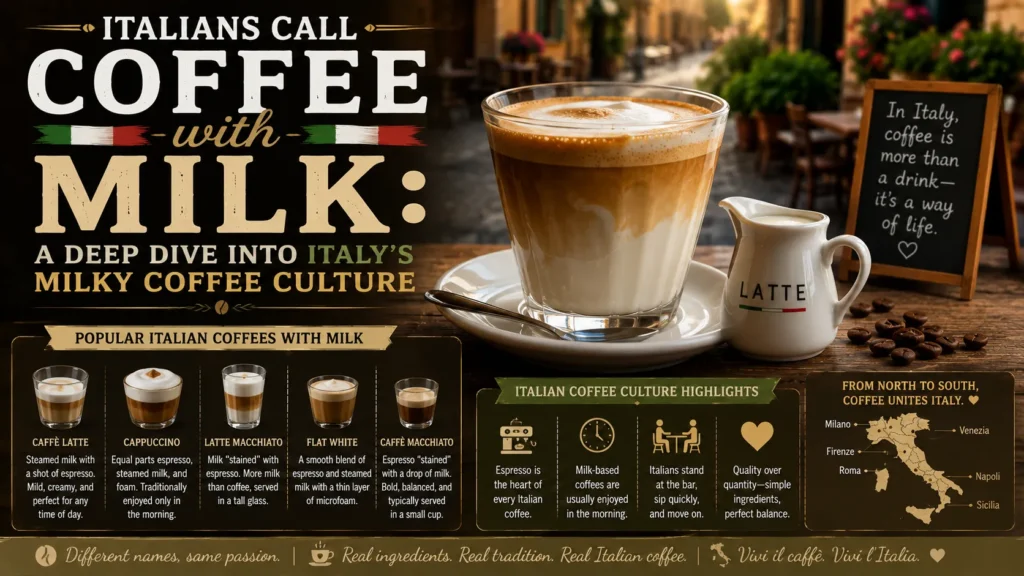
Although Italians Call Coffee with Milk is a unifying concept, the actual drink differs from region to region. In the north, a cappuccino reigns supreme: equal parts espresso, steamed milk, and milk foam, served in a 150‑ml cup. The foam is dense enough to hold a sprinkle of cocoa or cinnamon.
Moving toward Tuscany and Umbria, the latte macchiato becomes popular. Here, steamed milk is poured first, then “marked” with a shot of espresso, creating a layered effect. The drink is typically larger, around 200 ml, and enjoyed slowly during a mid‑morning break.
In southern Italy, especially around Naples and Sicily, the caffè latte dominates. This version features more milk than foam, yielding a creamier texture. Locals often enjoy it with a sweet pastry, such as a sfogliatella, while standing at the bar.
Additionally, some coastal bars offer a “marocchino,” a twist that adds a dusting of cocoa powder and sometimes a hint of orange zest. Despite these variations, the underlying principle remains: Italians Call Coffee with Milk to highlight the harmony between espresso and milk.
The timing of Italians Call Coffee with Milk is as important as the preparation. Italians traditionally consume milky coffee only in the morning, believing that milk slows digestion later in the day. After 11 a.m., you will rarely see a local ordering a cappuccino; instead, they opt for a straight espresso or a caffè corretto.
This custom is rooted in both health beliefs and social etiquette. Drinking a milky beverage after a meal is considered heavy, potentially causing discomfort. By reserving milk‑based drinks for the start of the day, Italians align their coffee habits with their culinary rhythm.
Furthermore, the act of ordering Italians Call Coffee with Milk at a bar is a brief, standing interaction. Patrons approach the counter, say their order, and enjoy the drink at the bar before heading to work or school. This practice fosters a sense of community, as regulars exchange greetings with the barista and fellow customers.
As a result, the ritual reinforces social bonds while delivering a moment of pleasure. Tourists who adopt this habit often report feeling more integrated into local life, experiencing Italy beyond the typical sightseeing itinerary.
Replicating the café experience begins with quality ingredients. Start with freshly roasted espresso beans, ground fine for a 25‑30 second extraction. Use an espresso machine or a stovetop moka pot to produce a rich, aromatic shot.
Next, focus on the milk. Whole milk yields the best foam due to its fat content, but baristas also succeed with 2 % or oat milk for those avoiding dairy. The goal is to create microfoam: tiny, uniform bubbles that give the drink a velvety mouthfeel.
Pour the steamed milk over the espresso, holding back the foam with a spoon if you prefer a cappuccino’s distinct layer. For a latte macchiato, reverse the order: pour milk first, then gently add the espresso shot. Finish with a light dusting of cocoa, cinnamon, or nutmeg if desired.
Moreover, serving temperature matters. Aim for 60‑65 °C (140‑149 °F) to preserve the espresso’s aromatics while keeping the milk pleasantly warm. Use a pre‑warmed cup to maintain heat longer, enhancing the overall sensory experience.
Finally, practice the pour. A steady, controlled stream creates latte art possibilities, from simple hearts to intricate rosettas. Even without art, the technique ensures a balanced Italians Call Coffee with Milk that honors the tradition.
One widespread myth is that Italians Call Coffee with Milk can be ordered at any time of day. In reality, most Italians consider it a morning beverage, and requesting a cappuccino after lunch may raise eyebrows among locals.
Another misconception involves the milk-to-espresso ratio. Some believe that more milk equals a better drink, but authentic Italians Call Coffee with Milk maintains a strong espresso presence. Over‑diluting the coffee diminishes the characteristic bitterness that balances the milk’s sweetness.
Lastly, many assume that any milk works equally well. While plant‑based alternatives can produce acceptable foam, they often lack the natural sweetness and texture of dairy milk, altering the traditional flavor profile. For a true Italians Call Coffee with Milk experience, whole milk remains the gold standard.
The mild acidity of espresso combined with the creaminess of milk creates a versatile companion for various Italian foods. In the morning, a cappuccino pairs beautifully with a cornetto (Italian croissant) or a slice of toasted bread spread with marmalade.
During a leisurely brunch, a latte macchiato complements savory options like a frittata or a plate of prosciutto and melon. The milk’s richness cuts through the saltiness of cured meats, while the espresso adds a refreshing contrast.
In the afternoon, although less common, a small caffè latte can accompany a biscotti or a piece of dark chocolate. The drink’s warmth enhances the chocolate’s cocoa notes, creating a satisfying finish to a light snack.
Furthermore, regional specialties inspire unique pairings. In Venice, locals enjoy a milky coffee with baicoli (thin, crisp biscuits) dipped gently into the cup. In Sicily, a granita al caffè served alongside a caffè latte offers a delightful interplay of hot and cold sensations.
When consumed mindfully, Italians Call Coffee with Milk can fit into a balanced diet. The espresso provides antioxidants and a modest caffeine boost, which may improve focus and metabolic rate. Milk contributes calcium, vitamin D, and protein, supporting bone health and muscle repair.
However, portion control remains essential. A typical cappuccino contains about 120‑150 calories, largely from milk. Adding sugar or flavored syrups can quickly increase the caloric load, so many Italians prefer their milky coffee unsweetened or with a mere teaspoon of sugar.
Additionally, individuals with lactose intolerance might opt for lactose‑free milk or a fortified plant‑based alternative. While the texture may differ, the core experience of Italians Call Coffee with Milk remains accessible.
As a result, enjoying this drink in moderation aligns with Italy’s broader approach to food: savor quality, respect tradition, and avoid excess.
As Italian coffee culture spreads worldwide, the phrase Italians Call Coffee with Milk serves as a cultural ambassador. Specialty cafés in New York, Tokyo, and Melbourne now offer authentic cappuccinos and latte macchiatos, educating international audiences about the nuances of the tradition.
Moreover, sustainability concerns are shaping the next generation of milky coffee. Many Italian roasters source beans from fair‑trade cooperatives, while dairy farms adopt regenerative practices to reduce environmental impact. These efforts ensure that Italians Call Coffee with Milk remains not only delicious but also responsible.
Finally, technology plays a role. Smart espresso machines with precise temperature controls and automated milk‑texturing systems allow home enthusiasts to replicate café‑level consistency. Yet, the human touch—the barista’s intuition and the social ritual—continues to define the true essence of Italians Call Coffee with Milk.
In conclusion, Italians Call Coffee with Milk is far more than a simple descriptor; it encapsulates history, geography, etiquette, and craftsmanship. Whether you are savoring a cappuccino at a Milanese bar, preparing a latte macchiato at home, or exploring regional variations abroad, this phrase invites you to participate in a living tradition that has warmed hearts and fueled conversations for generations.
Italians Call Coffee with Milk is a colloquial way of referring to any espresso‑based drink that includes steamed or frothed milk. Rather than naming a single recipe, the phrase highlights the Italian practice of describing beverages by their preparation method—espresso first, milk second—emphasizing the barista’s skill and the drink’s balance.
Traditionally, Italians consider milky coffee a morning beverage. Ordering a cappuccino or latte after 11 a.m. is uncommon and may be seen as a tourist habit, because Italians believe milk slows digestion later in the day. Locals typically switch to a straight espresso or a caffè corretto after the morning hours.
You can use a stovetop moka pot to produce a strong espresso‑like brew. For the milk, heat it gently in a saucepan or use a handheld frother to create microfoam. Pour the milk over the moka pot coffee, adjusting the ratio to roughly one part coffee to two parts milk for a latte, or equal parts for a cappuccino‑style drink. Finish with a light dusting of cocoa if desired.
Yes. In the north, a cappuccino with equal parts espresso, steamed milk, and foam is standard. Central Italy favors the latte macchiato, where milk is poured first and “marked” with espresso. The south often serves a caffè latte with more milk and less foam. Some regions also offer specialties like the marocchino, which adds cocoa or spices.
Bring the taste of Italy into your kitchen today. Explore our curated selection of premium espresso beans, milk frothers, and traditional Italian cups—all designed to help you master the art of Italians Call Coffee with Milk. Click below to start your journey toward the perfect milky coffee.




Here’s a question most of us never actually answer: how much caffeine did you really have today? That morning latte, the mid-afternoon cold brew, the cola with lunch — they add up fast, and almost nobody does the math. So we built this caffeine calculator…

Cold brew vs iced coffee vs iced espresso — the summer menu looks simple until you have to choose. They all show up in a glass of ice. But they don’t taste the same, they aren’t made the same way, and they don’t take the…

French press vs pour over vs espresso — three brewers, three very different cups of coffee. None of them is objectively “the best.” They just suit different mornings, different budgets, and different tastes. This guide compares all three honestly: how each one works, what the…

Explore the world of coffee with honest reviews and practical advice. Find your perfect cup, one bean and machine at a time.