
4 Best Coffee Brewing Methods for a Better Cup
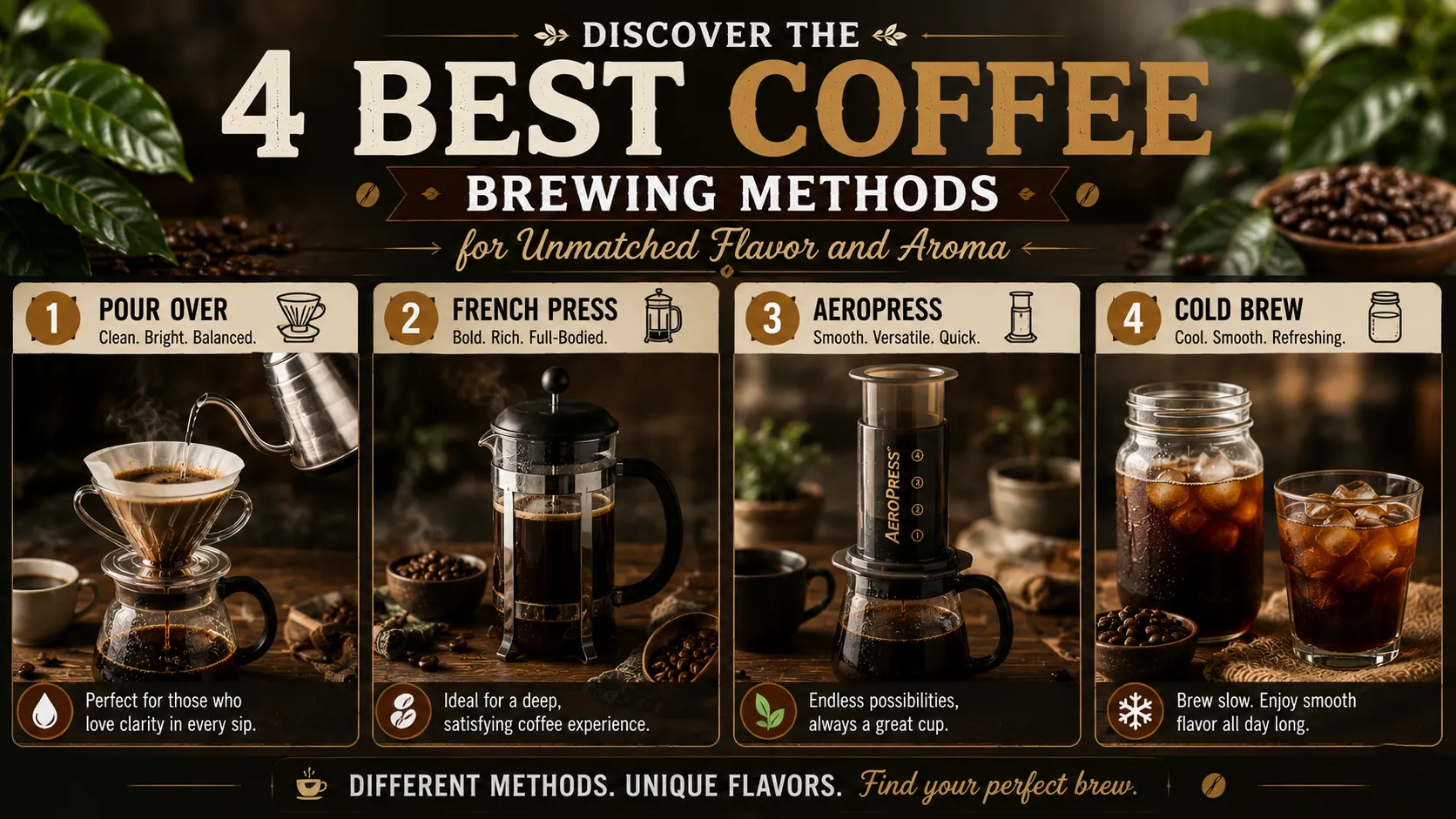
The four best coffee brewing methods are pour-over, French press, espresso, and cold brew. Pour-over gives you a clean, bright cup; French press makes a rich, full-bodied one; espresso delivers an intense shot that’s the base for lattes and cappuccinos; and cold brew is smooth and naturally sweet. Here’s how each one works, what gear you need, and how to get it right.
Quick comparison: the 4 best coffee brewing methods
| Method | Grind size | Brew time | Taste profile | Effort |
|---|---|---|---|---|
| Pour-over | Medium-fine | 2–4 minutes | Clean, bright, sweet finish | Medium — steady pouring |
| French press | Coarse | 4 minutes | Rich, full-bodied, chocolatey | Low — add water, wait, press |
| Espresso | Fine | 25–30 seconds | Intense, syrupy, crema on top | High — grind, tamp, dial in |
| Cold brew | Coarse | 12–24 hours | Smooth, mellow, low-acid | Low — but plan ahead |
1. Pour-over: clean and bright
Pour-over is the method for tasting what your coffee actually tastes like. Hot water passes through the grounds once, so delicate floral and citrus notes come through clearly instead of getting buried.
You need: a dripper (V60, Chemex, or similar), a paper filter, a gooseneck kettle, a scale, and fresh medium-fine grounds.
How to do it:
- Place the filter in the dripper and rinse it with hot water — this washes away any papery taste. Discard the rinse water.
- Add your grounds and set the scale to zero. Start with a 1:16 ratio — for example, 20 grams of coffee to 320 grams of water.
- Pour just enough water to wet the grounds (about twice their weight) and let them “bloom” for 30 seconds.
- Pour the rest of the water in slow, steady circles, keeping the water level even.
- Aim for a total brew time of about 2–4 minutes.
Water temperature: 195–205 °F (90–96 °C).
Tuning it: if the cup tastes sour or thin, grind a little finer or extend the pour. If it tastes bitter or harsh, grind a little coarser. Change one thing at a time so you know what made the difference.
2. French press: rich and full-bodied
French press is immersion brewing at its simplest — coarse grounds steep directly in hot water, and a metal plunger holds them back when you pour. You get more oils and fine particles in the cup, which means a heavier body and deep chocolatey, nutty flavors.
You need: a French press, a burr grinder set to coarse, and a timer.
How to do it:
- Add coarse grounds to the empty press.
- Pour hot water (about 200 °F / 93 °C) over all the grounds and stir gently so everything gets wet.
- Put the lid on with the plunger pulled up and steep for 4 minutes.
- Press the plunger down slowly and pour immediately — coffee left sitting on the grounds keeps extracting and turns bitter.
Tuning it: a muddy, silty cup usually means the grind is too fine. Bitterness means the steep ran long or the water was too hot.
French press is the most forgiving method on this list — if you’re new to brewing, start here.
3. Espresso: intense and concentrated
Espresso is a short, pressurized shot that forms the base of Americanos, lattes, and cappuccinos. Done well, it’s syrupy and balanced with a layer of golden crema on top.
You need: an espresso machine, a grinder that can grind fine, a tamper, and a scale.
How to do it:
- Dose 18–20 grams of finely ground coffee into the portafilter, level it, and tamp evenly with firm, consistent pressure.
- Lock the portafilter in and start the shot. Aim for 25–30 seconds, yielding about 36–40 grams of liquid (roughly a 1:2 ratio).
- Taste and adjust the grind: a shot that runs fast and tastes sour is under-extracted (go finer); one that drips slowly and tastes bitter is over-extracted (go coarser).
Water temperature: around 200 °F (93 °C) at roughly 9 bars of pressure.
Honest note: espresso asks the most of you — good gear, fresh beans (ideally within a few weeks of roast), and daily grind adjustments. It’s the hardest method on this list, and also the one that teaches you the most about extraction.
4. Cold brew: smooth and low-acid
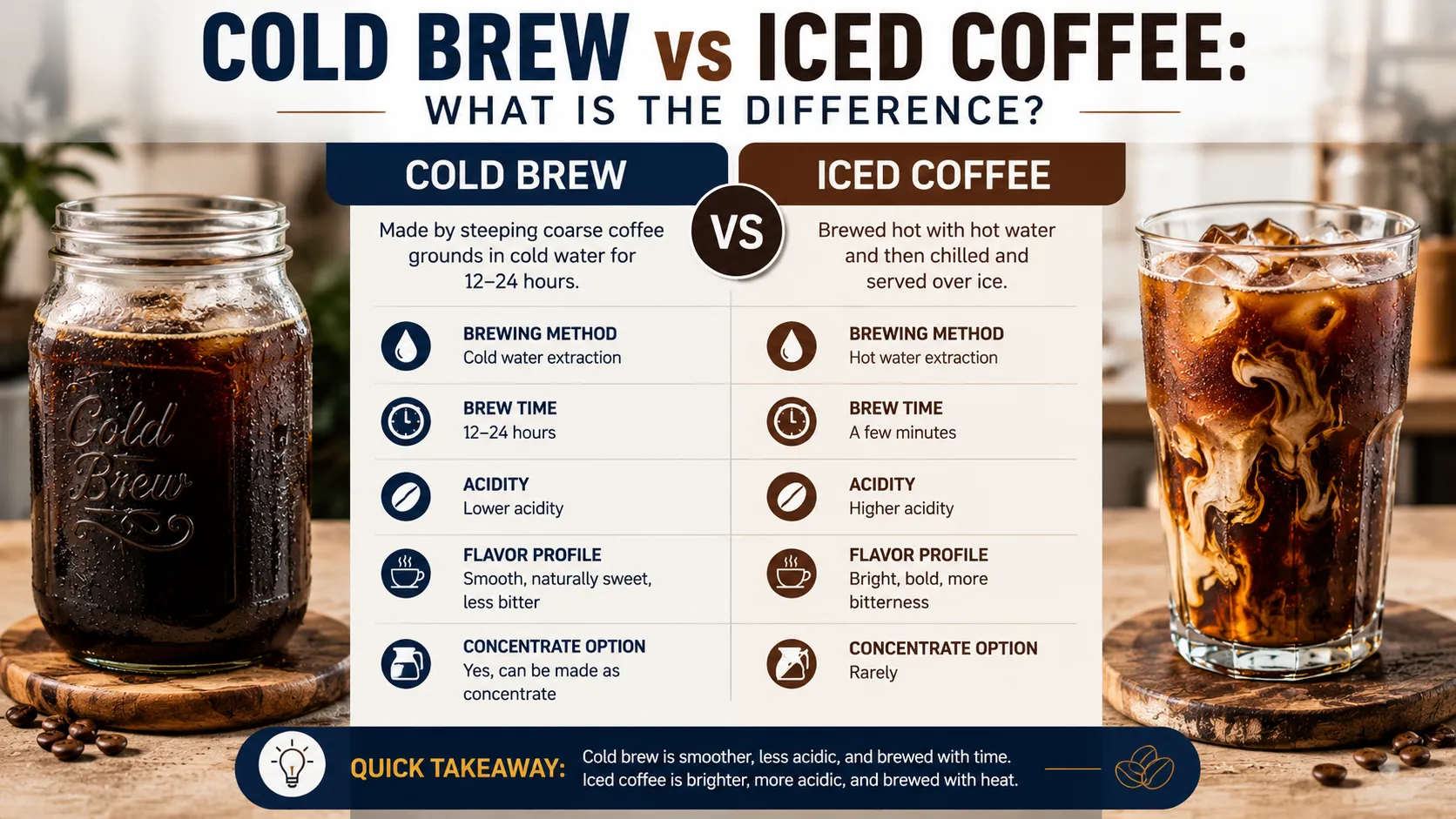
Cold brew trades heat for time. Coarse grounds steep in cold water for 12–24 hours, and the slow extraction pulls out sweet, mellow flavors while leaving much of the bitterness behind. It’s naturally sweet, easy on the stomach, and great over ice.
You need: a large jar or cold brew maker, coarse grounds, and a fine-mesh sieve or cheesecloth for straining.
How to do it:
- Combine coffee and cold water at roughly a 1:8 ratio by weight (for example, 100 grams of coffee to 800 grams of water). Stir so all the grounds are wet.
- Cover and steep in the fridge (or at room temperature) for 12–24 hours.
- Strain out the grounds, then dilute the concentrate with water or milk to taste and serve over ice.
Storage: keep the concentrate in a sealed container in the fridge and use it within about two weeks.
Which method should you pick?
- You want to taste the coffee itself — pour-over. It’s the best way to explore single-origin beans.
- You want a rich, comforting mug with minimal fuss — French press.
- You want milk drinks or the strongest flavor per sip — espresso.
- You want something smooth, cold, and ready ahead of time — cold brew.
- You’re on a budget — pour-over and French press gear costs far less than an espresso setup. Cold brew needs almost nothing beyond a jar.
No method is “best” in the abstract. The right one is the one that matches your taste, your mornings, and the gear you’re willing to buy.
Tips that work across all four methods
- Weigh your coffee and water. Spoons are inconsistent; a scale isn’t expensive and it changes everything.
- Use decent water. If your tap water tastes off, your coffee will too. Filtered water is a cheap upgrade.
- Grind fresh. Pre-ground coffee goes stale fast. A burr grinder matters more than expensive beans.
- Store beans properly. Airtight container, away from light, heat, and moisture.
- Keep a simple log. Grind setting, dose, time, temperature, and how it tasted. Your future self will thank you.
Troubleshooting: bitter, sour, or weak?
- Bitter or harsh (over-extracted): grind coarser, lower the water temperature a touch, or shorten the brew time.
- Sour or thin (under-extracted): grind finer, raise the water temperature, or extend the brew time.
- Uneven or muddy (common in pour-over and espresso): spread the grounds evenly before brewing — clumps and channels cause weak spots.
- Stale or off flavors: clean your gear. Old oils and mineral buildup quietly ruin good coffee.
Frequently asked questions
What grind size should I use for each brewing method?
Pour-over: medium-fine, like table salt. French press: coarse, like breadcrumbs. Espresso: fine, almost powdery. Cold brew: coarse, like sea salt crystals. These are starting points — adjust to taste.
Which brewing method is best for beginners?
French press. It needs almost no technique — add grounds, pour hot water, wait four minutes, press. Cold brew is equally simple but needs advance planning; pour-over takes pouring practice; espresso takes real patience.
Which brewing method makes the strongest coffee?
Espresso is the most concentrated per ounce. But “strong” can also mean caffeine per serving — and a big mug of French press can carry more total caffeine than a single espresso shot simply because there’s more of it. Grind, ratio, and serving size matter more than the method alone.
Is pour-over better than French press?
They’re different, not better or worse. Pour-over gives a cleaner, brighter cup that highlights origin flavors. French press gives a heavier, richer cup with more body. If you love light, fruity coffees, pour-over will show them off. If you love dark, chocolatey coffees, French press leans into that.
How does water temperature change the result?
Temperature controls which compounds dissolve. Too hot and you pull out bitterness; too cool and you get sour, thin coffee. For hot methods, stay near 195–205 °F (90–96 °C). Cold brew skips heat entirely and uses time instead.
Can I reuse coffee grounds for a second brew?
You can, but the second cup will be much weaker and flatter — the first brew pulls out most of the soluble flavor. For a good cup, always start with fresh grounds.
How long does cold brew keep in the fridge?
Stored in a sealed container, cold brew concentrate keeps well for up to two weeks. If it smells off or tastes flat, it’s done.