

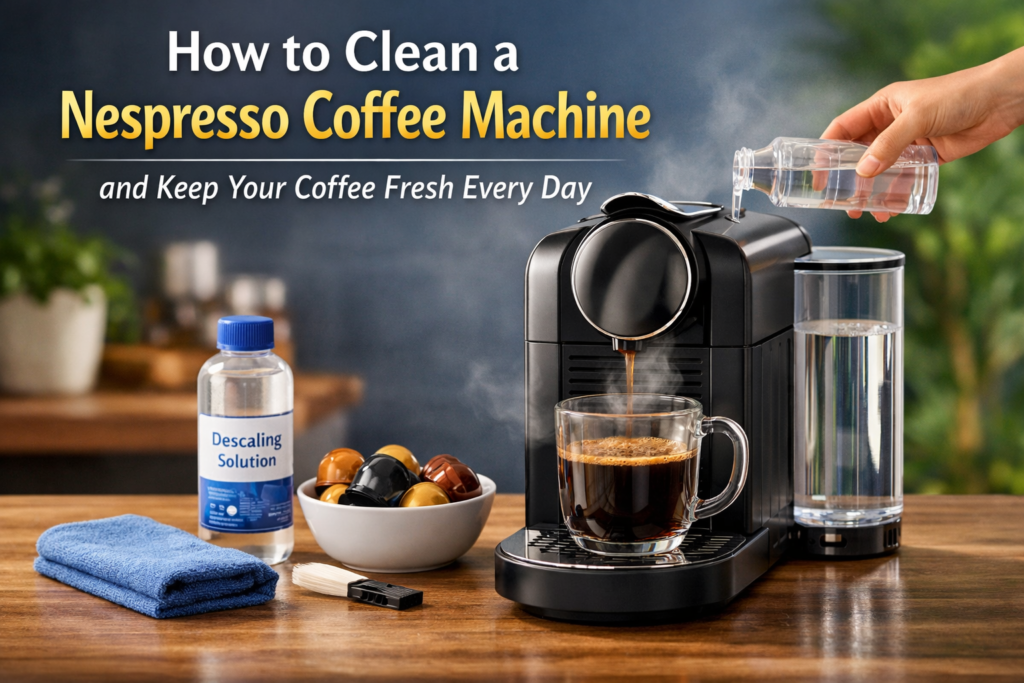
If your Nespresso coffee is tasting flat, bitter, or just a little off, the machine probably isn’t broken — it probably just needs a good clean. The quick version: wash the drip tray, water tank and capsule container with warm soapy water, wipe the brewing head and outlet, then run three to five water-only cycles through the machine. Do this every couple of weeks and your coffee will taste the way it should.
Coffee oils and limescale build up inside every Nespresso machine over time, and they quietly ruin both flavour and flow. A bit of regular maintenance costs you ten minutes and saves you from expensive repairs — or a machine that slowly stops working. This guide covers daily care, deep cleaning, and descaling for both Original and Vertuo models, plus the mistakes that cause the most damage.
Most of the work is simple and takes a few minutes. After each brewing session, eject the used capsule and empty the capsule container and drip tray — leaving damp used capsules sitting around is the fastest way to get a stale smell in your coffee. Give the drip tray a rinse under warm water, or wipe it down.
Once a week, give the removable parts a proper wash:
Then run a water-only rinse cycle: fill the tank with fresh water, put a mug under the outlet, and brew without a capsule. Do this three to five times. Hot water flushing the system pushes out leftover coffee oils from the brewing chamber — the residue that slowly turns your coffee bitter.
Different parts need attention at different intervals. Here’s a simple schedule that works for most households:
| Task | How often | Why it matters |
|---|---|---|
| Empty capsule container and drip tray | Daily or every other day | Prevents stale smells and mould |
| Run water-only rinse cycles | Every 2–3 days | Flushes coffee oils from the brewing chamber |
| Wash water tank, drip tray, capsule container | Weekly | Keeps removable parts fresh and hygienic |
| Wipe brewing head and coffee outlet | Weekly | Stops residue clogging the outlet |
| Full descale | Every 3 months (or after ~300 capsules) | Removes limescale from the heating system |
If you live in a hard-water area, you’ll likely need to descale more often. Many Nespresso models flash an orange or steady blinking light when they decide it’s time — treat that as a firm nudge rather than a suggestion.
The routine above works for every Nespresso, but the two machine families differ in a few useful ways.
Original Line (Essenza, Pixie, Citiz, Lattissima, Creatista): These use high-pressure extraction, and the brewing head area collects coffee grounds around the capsule cage. After ejecting a capsule, check the brewing head and wipe away any loose grounds with a soft cloth or small brush. If your machine has a milk frother or steam wand (Lattissima, Creatista), purge it after every use and soak the frothing parts in warm soapy water — dried milk is far worse for flavour than coffee residue.
Vertuo Line (Vertuo, Vertuo Next, Vertuo Plus): Vertuo machines spin the capsule at high speed (centrifugation), so the inside of the head gets coated with fine coffee mist. Wiping the inside of the head with a damp cloth once a week makes a noticeable difference. Vertuo machines also have a dedicated cleaning mode: on most models you press the button three times in two seconds to run a full cleaning cycle, which flushes the system more thoroughly than a normal water brew. Check your model’s manual for the exact button sequence.
Descaling is different from cleaning — it dissolves the limescale that builds up inside the heater and pipes. Without it, the machine brews cooler, flows slower, and eventually throws an error.
Never brew coffee until the rinse cycles are done — leftover descaling solution tastes awful and isn’t something you want in your cup.
This is where a lot of people go wrong. Nespresso’s own guidance is clear on these points, and they’re worth taking seriously:
Fill the water tank with fresh water, place a container under the coffee outlet, and run the machine without inserting a capsule. Let hot water pass through the system three to five times to flush out coffee residue and oils. Vertuo models also have a dedicated cleaning mode (usually three quick button presses) that runs a deeper flush.
Deep cleaning means three things done together: wash all removable parts (water tank, drip tray, capsule container) in warm soapy water, wipe down the brewing head and outlet area, and run a full descaling cycle followed by fresh-water rinses. Do this every three months.
Roughly every three months, or after about 300 capsules — whichever comes first. Hard water shortens that interval. If your machine’s descale light comes on, descale as soon as you can.
For daily and weekly cleaning, yes — warm water and mild dish soap handle the removable parts, and water-only cycles flush the brewing system. For actual descaling, though, use a proper coffee-machine descaler rather than vinegar. Nespresso advises against vinegar because it can damage internal components and may affect your warranty.
Bitterness that appears out of nowhere is most often stale coffee oil coating the brewing chamber. Run several water-only cycles and wipe the brewing head — that usually fixes it. If the flow is also slow or the coffee is lukewarm, the machine likely needs descaling.
Purge the steam wand right after each use (a quick burst clears milk from the tip), then wipe it with a damp cloth. Removable frothing parts should be washed in warm soapy water after each use — dried milk builds up fast and is hard to remove once it sets.
Cleaning a Nespresso machine isn’t complicated — most of it is a weekly wash of the removable parts and a few water-only cycles. The one step people skip is descaling, and it’s the one that matters most for keeping the machine heating properly and brewing at full flavour. Put a reminder in your phone for every three months, use a proper descaling solution, and your Nespresso will keep making the coffee you paid for.





Here’s a question most of us never actually answer: how much caffeine did you really have today? That morning latte, the mid-afternoon cold brew, the cola with lunch — they add up fast, and almost nobody does the math. So we built this caffeine calculator…

Cold brew vs iced coffee vs iced espresso — the summer menu looks simple until you have to choose. They all show up in a glass of ice. But they don’t taste the same, they aren’t made the same way, and they don’t take the…

French press vs pour over vs espresso — three brewers, three very different cups of coffee. None of them is objectively “the best.” They just suit different mornings, different budgets, and different tastes. This guide compares all three honestly: how each one works, what the…

Explore the world of coffee with honest reviews and practical advice. Find your perfect cup, one bean and machine at a time.