Coffee Tasting Notes Explained: How to Read the Flavor Wheel on Your Next Cup
The Short Answer
Here is the coffee tasting notes flavor wheel explained in one sentence: the notes on a coffee bag describe what the coffee reminds you of, not what was added to it. The flavour wheel is the chart that organises those descriptions, from broad ideas in the middle to precise flavours at the edge.Start with three simple questions — is it sweet, sour or bitter? Then move outward on the wheel until you find the word that matches what you taste. Your next cup is the practice ground. Brew it black, take a slow sip, and pick one word from the wheel before you reach for milk or sugar.What Tasting Notes Actually Are
Tasting notes are impressions, not ingredients. When a bag says blueberry, jasmine or dark chocolate, nobody stirred blueberries, flowers or chocolate into the beans. The flavours were already in the coffee. They come from the plant variety, the soil, the altitude, the cherry processing, and the roast level. A roaster tastes the finished coffee, notices what it reminds them of, and writes down the closest words.That is why the same bean can carry different notes from different roasters. One person tastes blueberry, another tastes blackberry, and both are describing the same fruity sweetness in slightly different words. The notes are a guide to what you might notice, not a promise of exactly what you will taste.Processing is the biggest reason a coffee tastes of fruit that was never added. In natural processing, the whole cherry dries with the fruit still on the bean. Some of the fruit’s flavour compounds end up in the cup. That is how an Ethiopian coffee can genuinely taste of blueberry or strawberry. In washed processing, the fruit is removed before drying, so the cup tastes cleaner and brighter, with floral and citrus notes showing through instead.The Flavour Wheel in 60 Seconds
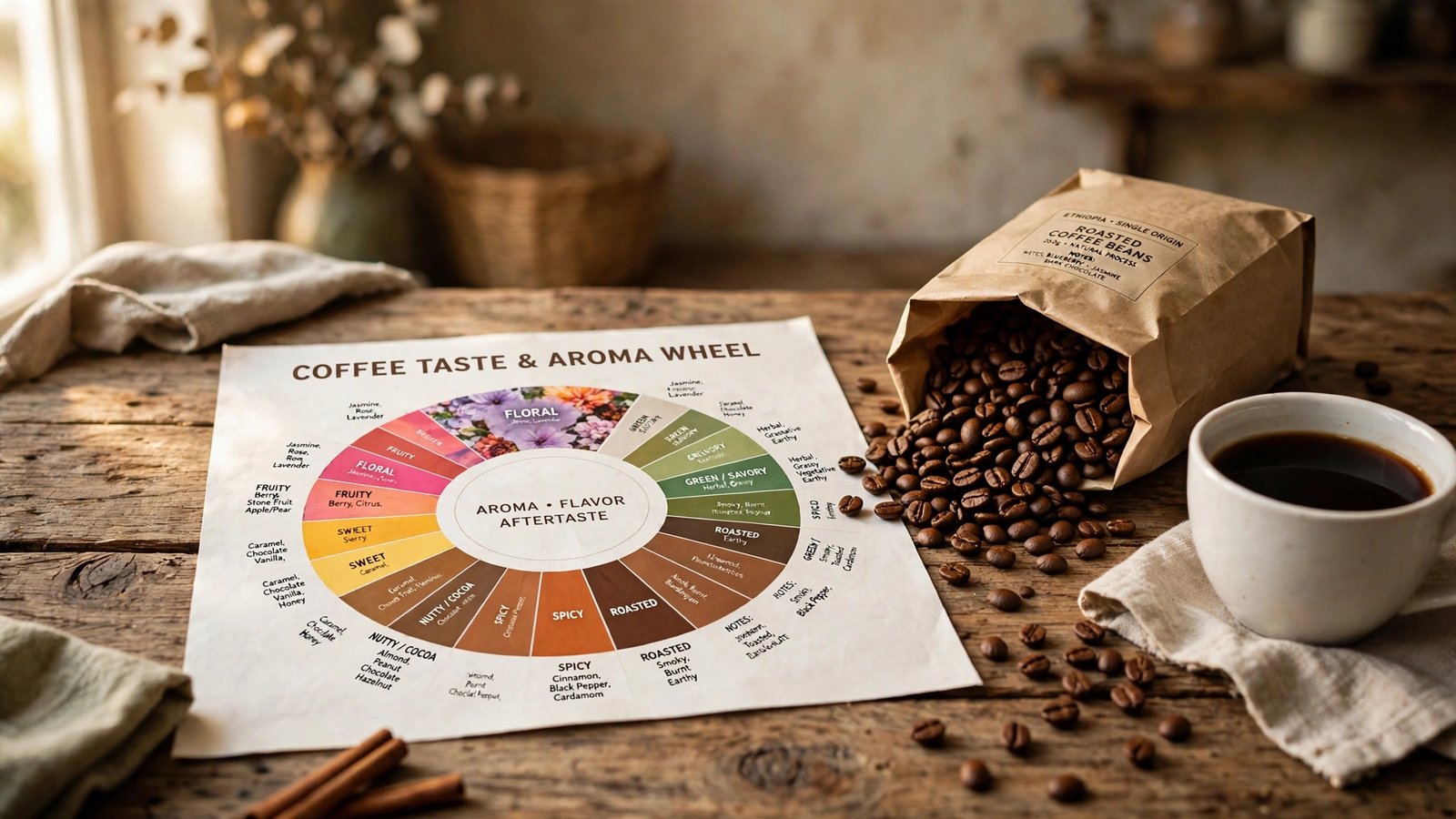
The chart roasters use is the SCA Coffee Taster’s Flavor Wheel. It was first published in 1995 and redrawn in 2016 with World Coffee Research, and it holds 110 flavours arranged in nine inner categories.That is the coffee tasting notes flavor wheel explained in brief. You read it from the centre outward. The middle holds broad ideas like fruity or sweet, the next ring narrows them down, and the outer edge gives you the precise word. Blueberry, jasmine, dark chocolate — those live on the edge.The wheel is not a test with right answers. It is a shared vocabulary: a roaster in Ethiopia and a drinker in Chicago mean roughly the same thing when they both say “blueberry”. You do not need to memorise it. Most people taste something first, then look at the wheel to find the word. That is the whole skill, and it gets easier fast.The 9 Categories, Plainly Explained
The nine inner categories are floral, fruity, sour/fermented, green/vegetative, other, roasted, spices, nutty/cocoa and sweet. Each category covers a family of flavours. Learning the families first makes the outer ring far less intimidating — you only need to narrow down one family at a time.| Category | What it covers | You will often taste it in |
|---|---|---|
| Floral | Jasmine, rose, lavender, orange blossom | Light-roast Ethiopians and other high-altitude washed coffees |
| Fruity | Berry, citrus, stone fruit, dried fruit | Washed Ethiopians, Kenyans, natural-processed lots |
| Sour/Fermented | Winey, tangy, vinegar-like brightness | Very bright coffees and some natural-processed lots |
| Green/Vegetative | Grassy, herbal, pea-like, hay | Very light roasts and under-developed beans |
| Other | Papery, chemical, musty, stale | Old, stale or poorly stored coffee — usually a warning sign |
| Roasted | Smoky, burnt, tobacco, charred | Dark roasts |
| Spices | Cinnamon, clove, black pepper, cardamom | Sumatran and some Central American coffees |
| Nutty/Cocoa | Hazelnut, almond, milk and dark chocolate | Brazilian and Colombian coffees |
| Sweet | Caramel, honey, vanilla, brown sugar, molasses | Medium roasts, especially Colombians and Central Americans |
How to Read the Wheel, Step by Step
Reading the wheel is a process, not a talent. Follow the same order every time and the chart stops looking like a wall of words.- Brew it black and let it cool. Hot coffee hides flavour. Everything tastes the same straight off the boil, and milk or sugar covers up the notes you are trying to find. Take a slow sip and let it coat your tongue.
- Ask sweet, sour or bitter? One of them usually stands out. Sweet points toward the sweet, nutty/cocoa or fruity families. Sour points toward fruity or sour/fermented. Bitter points toward roasted.
- Move one ring out. Find the broad family in the centre of the wheel. If the coffee tastes fruity, the next ring asks whether it is berry, citrus, stone fruit or dried fruit. Pick the group that fits best.
- Find the precise word at the edge. Berry becomes blueberry or strawberry; citrus becomes lemon or grapefruit. If no outer word fits, step back one ring — a close word beats a wrong one. Writing “berry” in your notes is a real result.
Common Notes by Origin
Origins are the fastest shortcut on the wheel. The same growing conditions keep producing the same flavour families, so the notes on the bag usually follow the origin. This table covers the origins you are most likely to see.| Origin | Notes you will often see | Why they show up |
|---|---|---|
| Ethiopia | Blueberry, jasmine, lemon, bergamot | Heirloom varieties, high altitude, washed and natural processing. Our guide to Ethiopian coffee beans breaks down each region’s character. |
| Colombia | Caramel, milk chocolate, nutty, red apple | Balanced, medium acidity, steady growing conditions |
| Brazil | Hazelnut, dark chocolate, low acidity | Lower altitude, heavier body, smooth rather than bright |
| Kenya | Blackcurrant, grapefruit, wine-like | Bright acidity from high-altitude growing and washed processing |
| Sumatra | Earthy, dark chocolate, spice | Wet-hulled processing and a humid climate |
| Central America | Cocoa, citrus, brown sugar | Volcanic soil and high altitude, especially Guatemala and Costa Rica |
Use It on Your Next Cup
You do not need a special setup to practise — the cup you brew tomorrow morning is enough. Cupping, the tasting procedure professionals use, is a separate skill from reading the wheel; the wheel is the vocabulary, cupping is the method. For this exercise, one cup and the wheel are all you need.- Brew it black. Make your coffee however you normally do and pour a small cup. Let it sit for a minute so it cools to drinking temperature.
- Sip and ask the three questions. Take a sip, roll it around your mouth, and swallow. Is it sweet, sour or bitter? Write down the one word that fits best, even if it feels vague.
- Walk the wheel outward. Find your broad family in the centre, move outward one ring, then another, until you reach a specific word. Write that word down next to the first one.
- Check the bag last. Only now look at the bag and compare. When your word matches the bag’s notes, you have just tasted like a professional. When it does not, trust your palate. Bags describe the roaster’s cup, brewed their way, and your water, grind and brewer all shift the result.
Why Two People Taste Different Things
Two people can drink the same coffee and pick different words from the wheel, and neither of them is wrong. Taste is personal in ways that have nothing to do with skill. Genetics change how strongly you notice bitterness and acidity. What you ate before your coffee — toothpaste, breakfast, even a glass of orange juice — shifts what your tongue picks up.And your past cups set your reference points. If you grew up drinking dark roasts, a light Ethiopian can taste sour to you and bright to someone else.Brewing changes the cup too. The same beans taste different through a French press, a pour over and an espresso machine. A grind that is too fine, or water that is too hot, can bury the fruity notes under bitterness. That is why the wheel works best as a shared language rather than a scorecard. Its job is to help you describe what you taste, not to tell you what you should have tasted.Mistakes to Avoid
- Reading the bag first. Taste blind, pick your word, then check the bag. Reading the notes first tells your brain what to find, and you will find it whether it is there or not.
- Reaching for the most exotic word. If the coffee tastes fruity, write “berry” and stop. Forcing “boysenberry” because it sounds impressive teaches you nothing.
- Tasting coffee too hot. Let it cool for a minute. Hot coffee flattens everything into the same bitter warmth.
- Adding milk or sugar before tasting. Taste it black first, even if you always drink it with milk. You can add milk afterwards — but the notes are in the black cup.
- Treating every unusual note as a flaw. Wine-like brightness in a Kenyan is a feature. Papery or musty notes in an old bag are a warning. Learn which is which instead of rejecting everything unfamiliar.
- Expecting the bag to be exact. The roaster tasted their roast, their grind, their water. Your cup will be close, not identical, and close is enough.
Frequently Asked Questions
Why does my coffee bag say blueberry?
Because the coffee reminds the roaster of blueberry. Natural-processed beans dry with the fruit still on, so fruity flavour compounds end up in the cup. No blueberry was added — the word describes an impression, not an ingredient.
Are tasting notes the same as added flavours?
No. Added flavours come from syrups or flavouring oils, and the bag usually says so. Tasting notes describe flavours already in the bean, shaped by origin, processing and roast. If a bag lists ‘blueberry’ under tasting notes, nothing was mixed in.
Do I need the flavour wheel to enjoy coffee?
No — plenty of people love coffee without ever opening it. The wheel is a tool for naming what you already taste. It helps most when you are comparing two coffees or shopping for a new bag. Start with sweet, sour or bitter; the wheel can wait.
What if I can’t taste any of the notes?
That is normal at first. Taste black coffee and let it cool for a minute. Compare two different origins side by side — differences show up far more easily than single flavours. Give it a few cups before deciding your palate can’t do it.
Does a darker roast change the tasting notes?
Yes. Roasting creates new flavours and burns off others, so the same bean tastes different at light and dark roast. Light roasts keep more floral and fruity notes; dark roasts push toward chocolate, caramel and smoky notes instead.
The Short Version
Coffee tasting notes are impressions, not ingredients. The flavour wheel is simply the chart that organises them — broad families in the middle, precise words at the edge.
This is the coffee tasting notes flavor wheel explained the way you will actually use it. Brew black, let it cool, and ask sweet, sour or bitter. Then walk outward on the wheel until you find your word. Do it on your next cup, write the word down, and check the bag afterwards. After a week of that, the bag stops looking like a puzzle and starts reading like a menu.