
The Sensory Science Behind How Coffee Beans Are Roasted for Peak Flavor
Jump To
The Sensory Science Behind How Coffee Beans Are Roasted for Peak Flavor
That bitter, flat cup of coffee you drank this morning was a massive disappointment. You deserve a vibrant, aromatic brew that genuinely jumpstarts your day. Consequently, the secret to achieving this perfect cup lies entirely in the roasting process.
The magic happens during the thermal transformation of the green seed. Specifically, the moment coffee beans are roasted, hundreds of chemical compounds unlock to create the rich flavors you crave. Therefore, understanding this process changes how you select and enjoy your daily brew.
Key Takeaways
- Chemical Transformation: When coffee beans are roasted, they undergo a dramatic physical and chemical transformation that develops flavor.
- The First Crack: This critical milestone indicates the transition from a light roast to medium roast profiles.
- Heat Transfer: Roasters use a delicate balance of conduction and convection to cook the beans evenly.
- Degassing Period: Freshly roasted beans require a short resting period to release excess carbon dioxide.
Green coffee beans are actually the seeds of a sweet cherry-like fruit. However, in their raw state, they taste grassy, woody, and incredibly bitter. As a result, they require precise thermal application to become the aromatic brown beans we love.
Furthermore, the roasting process is both a delicate science and an expressive art. Roasters must manage temperature, airflow, and time with extreme precision. Consequently, even a few seconds of over-roasting can destroy a coffee’s unique regional characteristics.
The Chemistry Behind How Coffee Beans Are Roasted
To truly appreciate your morning cup, you must explore the molecular changes happening inside the drum. Consequently, as coffee beans are roasted, they lose water weight but gain physical volume. This expansion occurs because internal steam and gases push outward against the cell walls.
In addition, the heat triggers the famous Maillard reaction. This is the chemical reaction between amino acids and reducing sugars that browns the beans. Ultimately, this reaction creates the complex flavor compounds responsible for the nutty, chocolatey, and savory notes.
Meanwhile, another crucial process called caramelization begins as temperatures rise further. During this phase, simple sugars break down and develop rich, sweet flavor profiles. Furthermore, once coffee beans are roasted, they release carbon dioxide progressively over several days.
Subsequently, the organic acids within the bean begin to decompose. While citric and malic acids decrease, quinic and phosphoric acids may become more prominent. Therefore, the way coffee beans are roasted determines the balance of acidity and bitterness in your cup.
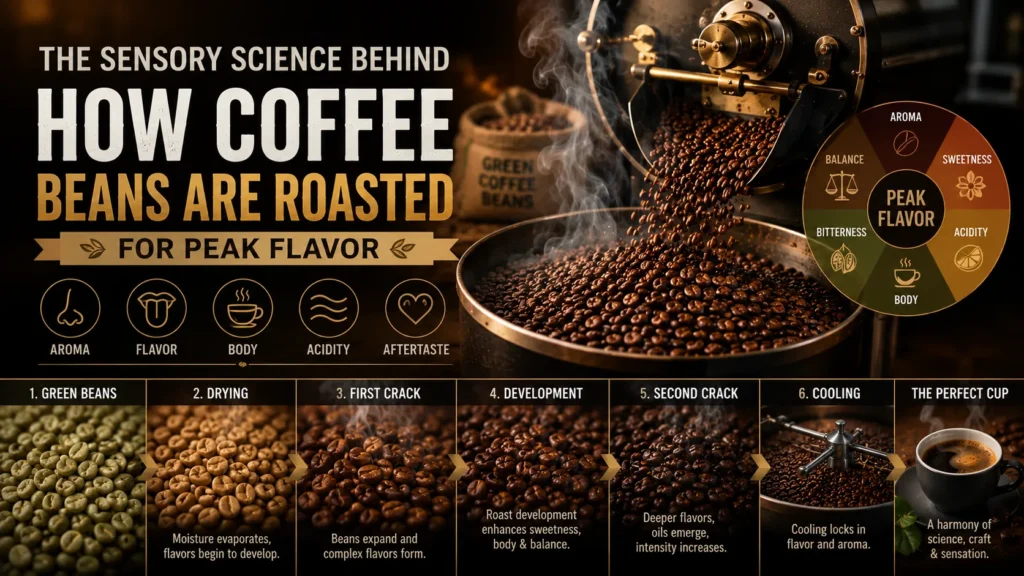
The Chronological Stages of the Roasting Cycle
Roasting is not a simple matter of applying heat until the beans look brown. Instead, it is a highly structured cycle consisting of distinct phases. Specifically, whenever coffee beans are roasted, the roaster must carefully control the heat application at each stage.
1. The Drying Phase
Initially, the green beans enter the hot roasting drum. Because green coffee contains up to 12% moisture, this water must be evaporated first. Consequently, the drum temperature drops rapidly before beginning its steady ascent.
During this stage, the beans absorb heat in an endothermic process. However, they do not change color immediately, remaining pale green or yellowish. Therefore, this phase is critical for preparing the inner bean structure for even heat distribution.
2. The Yellowing and Browning Phase
Once the moisture levels drop, the Maillard reaction officially begins. As a result, the beans transition from pale yellow to a warm, toasted brown. You will also notice a pleasant aroma of toasted bread or hay filling the room.
Furthermore, the physical structure of the bean begins to weaken. The silver skin, or chaff, starts to peel away from the bean. Consequently, roasters must use strong airflow to remove this combustible material from the drum.
3. First Crack and Development
As internal steam and gas pressure build to a climax, a loud popping sound occurs. This event is universally known as the “first crack” in the specialty coffee industry. As a result, before coffee beans are roasted beyond this point, they are considered light roasts.
Subsequently, the development phase begins, where the roaster fine-tunes the final flavor profile. During this brief window, the sugars caramelize and the acids balance out. However, if this phase is cut too short, the coffee will taste unpleasantly sour and grassy.
4. Second Crack (For Darker Roasts)
If the roaster continues to apply heat, the beans will undergo a second, quieter crack. This sound is caused by the physical fracturing of the brittle woody cellulose structure. In addition, oil begins to migrate to the surface of the bean.
Consequently, this stage produces classic dark roast profiles with oily, shiny surfaces. However, the unique origin characteristics of the coffee bean are largely replaced by roasty, smoky flavors. Therefore, high-quality specialty beans are rarely roasted this dark.
Understanding Roast Profiles and Flavor Characteristics
Every coffee variety possesses a unique genetic makeup shaped by its soil, altitude, and climate. However, the roast profile ultimately dictates which of these natural flavors are highlighted. In addition, after coffee beans are roasted, they must be cooled rapidly to halt the cooking process.
To help you choose the perfect bag, let us break down the three primary roast categories:
- Light Roasts: These beans are light brown, dry, and highly acidic. They showcase floral, citrusy, and tea-like notes because they preserve the bean’s original terroir.
- Medium Roasts: These feature a medium brown color with a balanced body and acidity. They highlight sweet, caramel, and nutty flavors, making them highly popular for daily drinking.
- Dark Roasts: These are dark brown to black, with a shiny, oily surface. They offer bold, smoky, and bittersweet chocolate notes with very low acidity.
Consequently, selecting a roast profile is a matter of personal preference. If you enjoy bright, fruity flavors, light roasts are your best option. Conversely, if you prefer a heavy body with chocolatey depth, choose a medium-dark or dark roast.
Variables That Influence Roast Quality
Achieving consistency in roasting is incredibly challenging due to environmental variables. Consequently, ensuring coffee beans are roasted evenly requires constant drum rotation and temperature monitoring. Even the ambient humidity in the roasting room can affect the final outcome.
This is crucial because coffee beans are roasted using both conductive and convective heat transfer. Conduction occurs when the beans touch the hot metal walls of the drum. Meanwhile, convection occurs as superheated air flows through the spinning mass of beans.
Furthermore, the Rate of Rise (RoR) is a critical metric for professional roasters. RoR measures how fast the bean temperature increases per minute. If the RoR drops too quickly, the roast can stall, resulting in a baked, flat flavor profile.
Therefore, modern roasters utilize advanced software to track these variables in real-time. By analyzing digital roast curves, they can replicate successful batches with incredible accuracy. Ultimately, this technology ensures that your favorite blend tastes exactly the same with every purchase.
Post-Roast Care: Keeping Your Beans Fresh
The journey does not end when the beans leave the cooling tray. Specifically, while coffee beans are roasted, they develop tiny pores that release gases over time. This process is known as degassing, and it is vital for flavor development.
Therefore, understanding how coffee beans are roasted helps you store them more effectively. Freshly roasted coffee should rest for three to seven days before brewing. If you brew them too early, the escaping carbon dioxide will disrupt the extraction, causing a sour taste.
In addition, oxygen is the ultimate enemy of roasted coffee. Once exposed to air, the delicate oils inside the bean begin to oxidize and go rancid. Consequently, you should always store your beans in an airtight container equipped with a one-way degassing valve.
Furthermore, avoid storing your coffee in the refrigerator or freezer. The constant temperature fluctuations cause condensation to form inside the bag. As a result, this moisture ruins the delicate flavor compounds and accelerates staling.
Related Coffee Topics You May Like
Frequently Asked Questions About Coffee Roasting
How much weight do coffee beans lose during roasting?
When coffee beans are roasted, they lose about 15% to 20% of their original green weight. This weight loss is primarily due to the evaporation of water moisture trapped inside the raw seed. In addition, some organic matter and chaff are lost during the process, while the bean physically expands in size.
How long should coffee beans rest after being roasted?
Consequently, after coffee beans are roasted, they need to rest for at least 24 to 48 hours before brewing. For optimal flavor, many specialty roasters recommend waiting three to seven days. This resting period allows excess carbon dioxide gas to escape, preventing bitter extractions and allowing the true flavor profile to emerge.
Can you brew green coffee beans without roasting them?
Indeed, unless coffee beans are roasted, they remain exceptionally hard and taste like bitter grass or wood. While you can technically steep green coffee beans in hot water to make a herbal tea, it will not taste like traditional coffee. The roasting process is absolutely essential to develop the aromatic oils and soluble flavors we enjoy.
Does roasting coffee reduce the caffeine content?
As a result, since coffee beans are roasted at high temperatures, many believe caffeine is lost. However, caffeine is actually highly stable during the roasting process. Darker roasts lose water weight and become lighter, meaning they contain more caffeine by bean count, while light roasts contain more caffeine by weight.
Ready to Taste the Perfect Roast?
Discover the difference when coffee beans are roasted to perfection by true artisans. Elevate your morning routine with our freshly roasted, single-origin selection today!

Moses Anthony
Moses Anthony is a coffee enthusiast and home brewing specialist with over 7 years of hands-on experience testing coffee beans, espresso machines, grinders, and brewing methods. He has spent years experimenting with pour-over, French press, drip coffee, and espresso to help everyday coffee drinkers brew better coffee at home.At Best Coffee Guide, Moses focuses on practical brewing tips, honest product comparisons, and beginner-friendly coffee education based on real testing and research. His goal is to simplify coffee brewing and help readers make better choices with confidence.
How to Make Coffee Easy: Effortless Tips for Barista‑level Brew at Home
September 17, 2026
No Comments
Read More » Mastering the Art: How to Make Coffee Darker for a Richer, Bold Brew
September 16, 2026
No Comments
Read More » 
How to Make Coffee Dip: Easy Steps to Create a Rich, Coffee-infused Spread
September 15, 2026
No Comments
Read More » Latest Pots
Imagine waking up, craving a rich cup, but feeling overwhelmed by complicated machines and vague recipes. You want great coffee without the fuss, and you deserve a method that works every single time. This guide shows you exactly how to make coffee easy, turning morning…
Many coffee lovers crave a cup that looks as deep and intense as its flavor promises. If your brew often turns out light or washed out, you’re not alone—achieving that striking darkness involves more than just adding extra grounds. In the next few paragraphs we’ll…

Explore the world of coffee with honest reviews and practical advice. Find your perfect cup, one bean and machine at a time.
Main Menu
Top Categories
Newsletter
Sign up our newsletter to get updated information, promo or insight for free.
Copyright © 2025 Best Coffee Guide, All rights reserved.