

Nothing ruins a quiet morning faster than a cup of coffee filled with bitter, muddy sediment. This frustrating experience usually happens when you use the wrong grind size for your brewer.
To solve this issue permanently, you must use coarse ground coffee for French press brewing. This specific grind size ensures a clean, full-bodied cup without letting fine particles slip through the metal mesh filter.
Consequently, understanding how to select, grind, and brew your beans will completely transform your daily coffee ritual. Let us explore why this simple adjustment yields such extraordinary flavor.
Key Takeaways
- Perfect Texture: Your grounds should resemble coarse sea salt to prevent over-extraction and muddy cups.
- Immersion Chemistry: Coarse grounds allow for a slow, even extraction during the four-minute steeping process.
- Grinder Choice: Always use a quality burr grinder to achieve the uniform consistency needed for French press.
- Optimal Ratios: Start with a 1:15 coffee-to-water ratio to balance strength and flavor clarity.
The Science of Immersion Brewing

To understand why grind size matters, we must first look at how the French press extracts flavor. Unlike drip methods that rely on gravity, the French press uses full immersion brewing.
Therefore, the coffee grounds remain in direct contact with hot water for the entire brewing duration. This prolonged exposure requires a careful extraction strategy to avoid bitterness.
As a result, a larger particle surface area is necessary to slow down the rate of extraction. If you use fine grounds, the water will extract soluble compounds far too quickly.
Furthermore, fine particles will easily bypass the built-in metal mesh filter. This leads to a gritty texture and an unpleasantly bitter taste profile.
By utilizing coarse ground coffee for French press, you ensure that only the delicious oils and soluble flavors end up in your mug. The larger grounds stay trapped safely beneath the plunger.
Why Coarse Ground Coffee for French Press is Non-Negotiable
Using the correct grind size is not merely a suggestion; it is a fundamental rule of immersion brewing. When you plunge the press, you apply physical pressure to separate the liquid from the solids.
However, fine grounds will clog the tiny openings in your metal filter screen. This clogging creates immense resistance, making it incredibly difficult to push the plunger down safely.
In addition, forcing a clogged plunger down can cause hot coffee to spray out of the carafe. This creates a dangerous kitchen hazard that can easily be avoided.
Conversely, coarse ground coffee for French press allows the water to glide through the filter smoothly. The plunger descends with minimal resistance, ensuring a safe and clean brewing experience.
Ultimately, this grind size strikes the perfect balance between extraction time and filtration efficiency. You get a heavy, velvety body without the unpleasant silt associated with finer grinds.
Identifying the Perfect Coarse Grind Texture
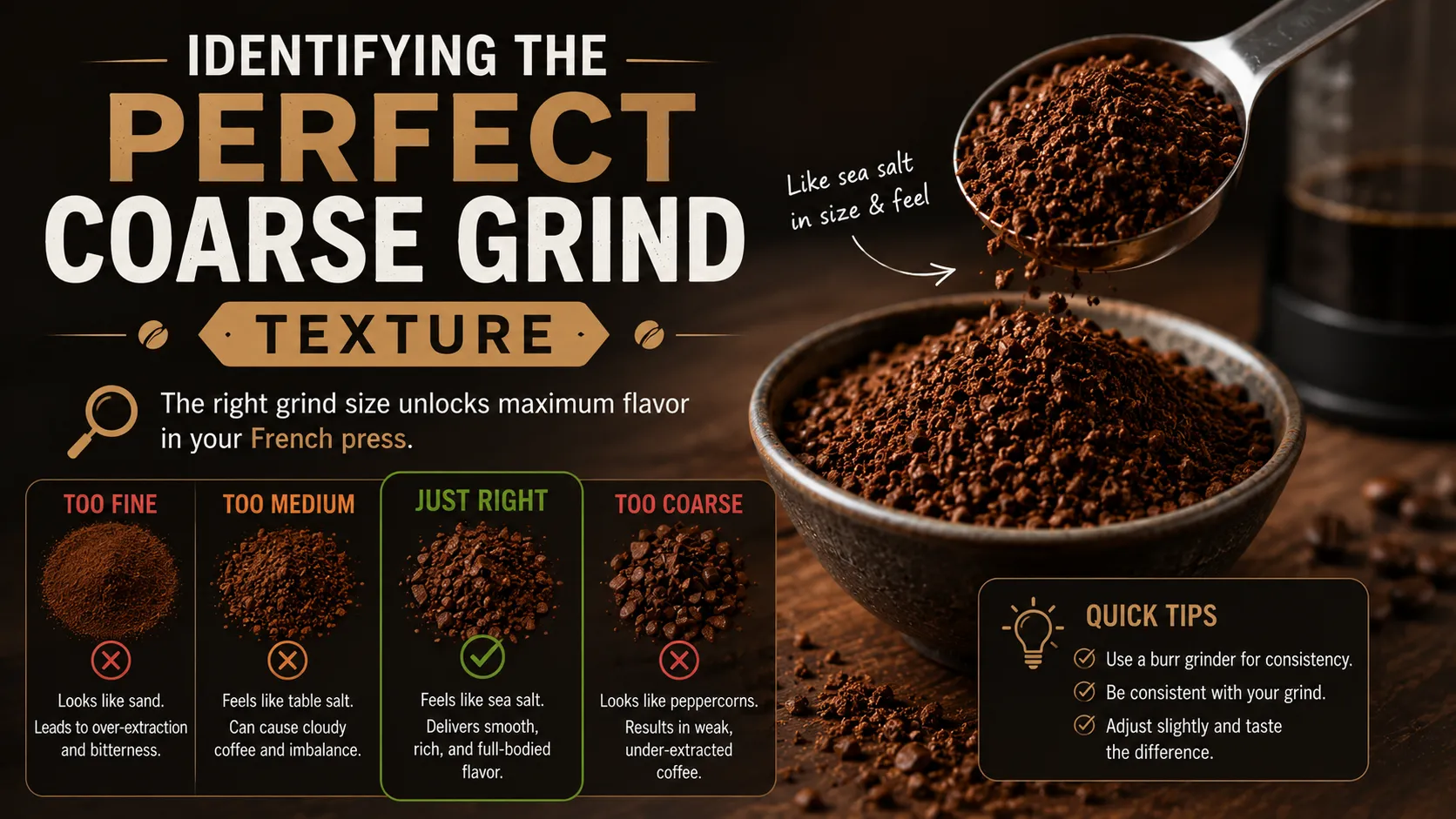
When preparing your beans, you might wonder what a proper coarse grind actually looks like. Visually, your coffee grounds should closely resemble coarse sea salt or kosher salt.
Specifically, the individual particles should be distinct, chunky, and relatively uniform in size. If you notice a lot of powdery dust mixed in, your grind is too inconsistent.
Consequently, these tiny dust particles, known as “fines,” will over-extract rapidly and cause bitterness. Therefore, achieving a highly uniform grind size is your main objective.
The Role of Burr Grinders
To achieve this level of consistency, you should avoid using blade grinders entirely. Blade grinders chop the beans randomly, producing a mixture of massive chunks and fine powder.
Instead, invest in a high-quality flat or conical burr grinder. Burr grinders crush the beans between two abrasive surfaces, which guarantees a highly consistent particle size.
As a result, using a burr grinder to prepare your coarse ground coffee for French press will dramatically improve your cup quality. The uniform extraction prevents both sourness and bitterness from developing simultaneously.
Visualizing the Sea Salt Analogy
If you are adjusting your grinder settings, start on the coarsest setting and work your way down. Rub the grounds between your fingers to test the texture.
It should feel rough and gritty, not soft or powdery like sand. If it feels like beach sand, your grind is still too fine for an immersion brewer.
Adjust the grinder to a slightly coarser setting until you achieve that distinct, rocky texture. This precise calibration is the secret to unlocking sweet, complex flavor notes.
The Golden Rules of French Press Brewing
While the grind size is critical, other variables also play a massive role in your final cup. You must manage your water temperature, brewing ratio, and steeping time carefully.
In addition, using fresh, high-quality water is essential since coffee is mostly water. Let us break down the exact formula for a perfect brew.
The Water-to-Coffee Ratio
For a balanced and rich brew, we highly recommend using a 1:15 coffee-to-water ratio. For example, if you use 30 grams of coarse ground coffee for French press, you will need 450 grams of water.
Alternatively, if you prefer a slightly lighter body, you can experiment with a 1:16 ratio. Using a digital kitchen scale is the best way to ensure accuracy every single morning.
Measuring by weight rather than spoons eliminates variables and ensures consistent results. Consequently, you can easily replicate your favorite brew day after day.
Perfecting the Water Temperature
Water that is boiling hot will scorch your coffee, while water that is too cool will under-extract it. Therefore, you should aim for a temperature between 195°F and 205°F.
If you do not have a temperature-controlled kettle, simply bring your water to a boil. Then, let it sit off the heat for about 30 to 45 seconds before pouring.
This brief cooling period brings the water into the ideal temperature range. As a result, you will extract the sweet and fruity notes without any burnt flavors.
The Crucial Bloom Phase
When hot water first hits fresh coffee grounds, they will begin to bubble and swell. This fascinating process is called “blooming,” which releases trapped carbon dioxide gas.
To bloom your coffee, pour just enough water to wet the coarse ground coffee for French press completely. Let it sit undisturbed for 30 seconds before adding the remaining water.
Furthermore, blooming allows the water to saturate the grounds evenly. This step prevents dry pockets from forming, which would otherwise lead to uneven extraction.
Step-by-Step Guide to the Ultimate Brew
Now that you understand the core variables, let us walk through the entire brewing process. Follow these steps carefully to achieve a coffeehouse-quality cup at home.
Step 1: Preheat Your Carafe. Pour some hot water into your empty French press to warm up the glass or metal. This step prevents the brewing water from dropping in temperature too quickly. Pour this water out before adding your coffee.
Step 2: Add Your Grounds. Place your freshly prepared coarse ground coffee for French press into the bottom of the preheated carafe. Give the press a gentle shake to level the bed of grounds.
Step 3: Begin the Bloom. Start your timer and pour hot water gently over the grounds until they are fully submerged. Let the mixture bubble and expand for exactly 30 seconds.
Step 4: Fill and Stir. Pour the remaining water up to your desired weight or fill line. Gently stir the crust of coffee on top with a wooden spoon to ensure complete saturation.
Step 5: Steep and Plunge. Place the lid on the press to retain heat, but do not plunge yet. Let the coffee steep for an additional three and a half minutes, bringing the total time to four minutes. Finally, press the plunger down slowly and evenly.
Troubleshooting Common French Press Mistakes
Even with the best intentions, you might occasionally encounter flavor issues. Fortunately, most brewing problems are incredibly easy to diagnose and correct.
Specifically, if your coffee tastes sour or watery, your grind might actually be too coarse. In this scenario, the water cannot extract enough flavor in the four-minute window.
To fix this, make your grind slightly finer, or extend your steeping time by 30 seconds. Conversely, if your coffee is unpleasantly bitter, your grounds are likely too fine.
In addition, leaving the brewed coffee inside the French press after plunging will cause continuous extraction. Therefore, you should always decant the finished coffee into a thermal carafe immediately.
This simple step stops the brewing process instantly and keeps your beverage hot. Consequently, your last cup of coffee will taste just as delicious as your first.
Selecting the Best Beans for a Coarse Grind
Because the French press extracts a high amount of natural oils, it excels at highlighting rich, deep flavor profiles. Therefore, choosing the right roast profile is essential for maximizing your enjoyment.
Generally, medium to dark roasts perform exceptionally well with this brewing method. These roasts feature lower acidity and boast comforting notes of chocolate, caramel, and toasted nuts.
When you use coarse ground coffee for French press with a dark roast, you get a wonderfully bold cup. The heavy body of the immersion brew perfectly complements these robust flavor notes.
However, do not hesitate to try high-quality single-origin medium roasts. These beans can offer delightful undertones of stone fruit and spice without being overwhelmed by bitterness.
Ultimately, the key is to source freshly roasted beans from a local roaster. Fresh beans contain vibrant flavors and aromatic oils that pre-ground grocery store options simply cannot match.
How to Store Your Coarse Coffee for Maximum Freshness
Once you have achieved the perfect grind, keeping your coffee fresh should be your top priority. Oxygen, light, heat, and moisture are the ultimate enemies of roasted coffee beans.
Therefore, you should always store your beans in an airtight container. Keep this container in a cool, dark pantry rather than on your sunny kitchen countertop.
Furthermore, avoid storing your coffee in the refrigerator or freezer. The constant temperature fluctuations create condensation inside the bag, which quickly ruins the delicate oils.
Ideally, you should only grind the exact amount of coarse ground coffee for French press that you need right before brewing. This practice preserves the volatile aromas and guarantees the freshest cup possible.
Related Coffee Topics You May Like
Frequently Asked Questions
Can I use regular pre-ground coffee in a French press?
Generally, regular pre-ground coffee sold in grocery stores is designed for drip coffee makers and is ground far too fine. Using this in an immersion brewer will result in a bitter, muddy cup with lots of sediment. For the best experience, you should specifically buy coarse ground coffee for French press or grind your own beans at home.
Why is my French press so difficult to plunge?
If you experience heavy resistance while plunging, your grind size is likely too fine. Fine particles clog the metal mesh filter and restrict the flow of water. To resolve this, ensure you are using a consistent coarse ground coffee for French press and press down slowly using only the weight of your hand.
How long should I steep coarse ground coffee?
The standard recommended steeping time for a French press is four minutes. This duration allows the coarse grounds to release their desirable flavors without over-extracting. If you prefer a stronger body, you can experiment with a five-minute steep, but be careful to avoid bitterness.
What is the best ratio of coffee to water for French press?
The golden ratio for this brewing method is 1:15, meaning 1 gram of coffee for every 15 grams of water. For a standard 8-cup French press (about 32 ounces of water), you will want to use approximately 60 grams of coarse ground coffee for French press. This ratio delivers a robust body and balanced flavor.
Ready to Elevate Your Morning Brew?
Don’t settle for bitter, muddy coffee any longer. Upgrade your morning ritual with our premium, fresh-roasted beans perfectly suited for your French press.