



Coffee feels normal in most homes. It sits on breakfast tables, office desks, and café menus around the world. That is exactly why this topic confuses so many readers. When someone hears that certain religious people do not drink coffee, the first reaction is usually surprise. Then the questions start. Which religion avoids coffee? Is coffee really forbidden? Is it a health rule, a faith rule, or just a personal choice?
Most articles on this topic give a thin answer. They repeat the same two or three facts, skip the deeper reasons, and leave readers with more confusion than clarity. That is a problem, especially if you are writing for a blog that needs real value and stronger trust signals.
So this guide takes a better approach.
Most high-ranking articles miss an important detail. I examined where religion and culture do not enjoy a wonderful blend, where they mistakenly think that all Christians share the same view, and where most of the articles make coffee rules seem so easy to understand without explaining the spiritual context of those regulations. That small mistake shows up often, and it makes content sound generic very quickly.
This article will help you understand which faith groups avoid coffee, why they do it, how strict those beliefs are, and what readers should know before making assumptions. It also includes practical explanations, mistakes to avoid, real-world observations, and a clear comparison table so the content feels useful instead of recycled.
The most well-known religious group that avoids coffee is The Church of Jesus Christ of Latter-day Saints. Their members are taught not to drink coffee as part of a health code called the Word of Wisdom.
Many Seventh-day Adventists also avoid coffee because they place a strong focus on physical health, spiritual clarity, and avoiding stimulants. However, the way this is practiced can vary from person to person.
Other religions, such as Islam, Hinduism, Buddhism, and Jehovah’s Witnesses, do not have a universal rule that bans coffee for all followers. In these faiths, coffee is usually a matter of moderation, personal discipline, health, or spiritual routine rather than a strict religious prohibition.
|
Religion or Group |
Do They Avoid Coffee? |
How Strict Is It? |
Main Reason |
|
The Church of Jesus Christ of Latter-day Saints |
Yes |
Strong and clear |
Religious obedience and health guidance |
|
Seventh-day Adventists |
Often yes |
Moderate to strong |
Health, body care, spiritual discipline |
|
Islam |
No general ban |
Not forbidden |
Moderation and self-control |
|
Jehovah’s Witnesses |
No general ban |
Personal choice |
Health and balance |
|
Hinduism |
No universal ban |
Personal or cultural choice |
Moderation, fasting, spiritual focus |
|
Buddhism |
No universal ban |
Varies by tradition |
Calmness, mindfulness, meditation |
|
Rastafarianism |
Some may avoid it |
Personal lifestyle-based |
Natural living and simple habits |
One thing I noticed while reviewing your original draft is that this topic becomes weak very quickly when it is written too simply. The line “some religions do not drink coffee” sounds easy, but the truth is more layered.
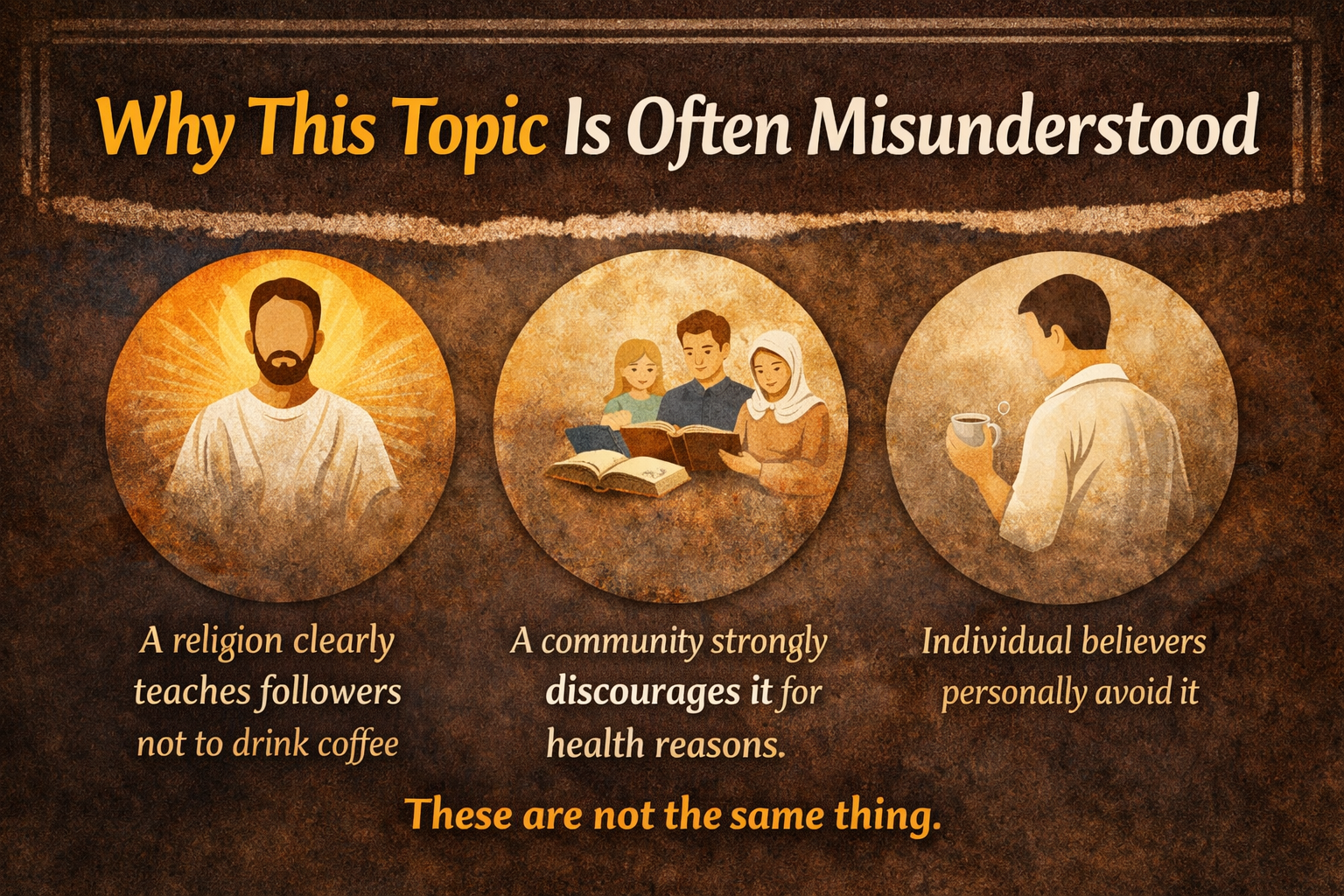
There are three different situations that people often mix:
These are not the same thing.
When people search for religions does not drink coffee, they are usually talking about The Church of Jesus Christ of Latter-day Saints.
This is the clearest and most widely recognized example. Members follow a religious health code known as the Word of Wisdom, and coffee is included among the drinks they are taught to avoid.
A lot of low-quality articles explain this in a shallow way by saying, “They avoid coffee because caffeine is bad.” That explanation is incomplete. The deeper reason is not only about caffeine or energy. For believers, this practice is connected to faith, obedience, and respect for the body.
That difference is important.
In real conversations, this is where many writers make mistakes. They reduce a spiritual commitment to a basic diet tip. That makes the topic feel flat and disrespectful. A better explanation is this: many Latter-day Saints avoid coffee because they believe their body is a gift from God and that following revealed guidance is part of living faithfully.
Decaf coffee confusion is one of the practical problems that I frequently encounter in publications and discussions on the internet. Many people assume that if caffeine is removed, the drink should be fine. But that is not how this belief is usually understood. For most Latter-day Saints, the issue is still coffee itself, not just the caffeine level.
That small detail helps separate useful content from generic content.
The second faith group commonly mentioned in this discussion is the Seventh-day Adventists.
Adventists are widely known for taking health seriously. Their lifestyle often includes attention to food quality, rest, exercise, and avoiding harmful habits such as smoking or alcohol. Many Adventists also choose to avoid coffee because they see stimulants as unhelpful for the body and mind.
This part of the topic needs careful wording. Unlike the Latter-day Saint teaching, the Adventist relationship with coffee is often described through a health and lifestyle lens rather than a single short rule repeated in the same way by every member.
That means many Adventists avoid coffee, but practice can still vary.

They often connect coffee avoidance with:
In content writing, this is where nuance improves quality. Instead of saying “Adventists never drink coffee,” it is more accurate and more trustworthy to explain that many avoid it because of health beliefs, while individual practice may differ.
This also explains why some Adventist households replace coffee with herbal drinks, grain-based hot drinks, or caffeine-free alternatives. That is a useful detail because it shows what this looks like in daily life, not just in theory.
Islam has a very different relationship with coffee.
Coffee has a long cultural and historical connection with Muslim societies. It was used in parts of the Muslim world centuries ago, especially in settings where people wanted to stay awake during late worship or social gatherings. At different times in history, some leaders questioned it, but coffee did not become a permanent universal ban in Islam.
Today, coffee is widely accepted in Muslim communities.
You can see this clearly in the cultural importance of:
So if a writer says Islam is a religion that does not drink coffee, that is inaccurate.
The confusion usually comes from fasting. During Ramadan, Muslims do not eat or drink during fasting hours, so naturally, coffee is not consumed at that time. But that is very different from saying coffee is forbidden by religion in general.
That distinction is essential.
There is no universal Hindu ban on coffee. Some Hindus drink coffee regularly, especially in places where it is part of local culture. Others may avoid it during fasting, prayer periods, or spiritual routines. In some cases, the concern is not coffee itself but overstimulation or attachment.
Buddhism also does not have one universal global coffee rule. Some practitioners avoid caffeine because they want a calmer mind for meditation. Others drink coffee in moderation, especially if it helps them stay awake without becoming excessive.
Jehovah’s Witnesses do not have a general religious ban on coffee. It is more a matter of personal judgment, health awareness, and moderation.
Some Rastafarians may avoid coffee as part of a natural lifestyle known as Ital living, which favors simple and less processed choices. Still, this is not the same as a universal formal ban in the way many readers think of religious rules.
Even when beliefs differ, the reasons often fall into a few clear patterns.
For some believers, especially Latter-day Saints, avoiding coffee is a direct part of faith practice.
For many Adventists and health-minded believers, coffee is avoided because they want to protect sleep, reduce dependence, and keep the body in better condition.
Some people avoid coffee because they want a calmer mind for prayer, worship, fasting, or meditation.
In many faith traditions, the deeper question is not “Is coffee evil?” but “Am I becoming dependent on it?”
This is an important shift. It makes the content more honest and more useful.
This section adds real value because many readers are not asking for themselves. They are trying to avoid awkward situations with guests, friends, classmates, or coworkers.
This sounds obvious, but it causes more small social mistakes than most people expect. In many homes and offices, offering coffee is automatic. But not everyone says yes, and the reason may be religious.
Pro tip: When offering drinks, say, “Would you like coffee, tea, water, or juice?” That feels more respectful and less pushy.
If someone says they do not drink coffee, avoid sounding shocked. A calm response works better.
You can say:
“I didn’t know that. Is it a health choice or part of your faith?”
That gives them room to answer without pressure.
One of the biggest writing mistakes is assuming every member of a religion behaves the same way. Real life does not operate like that. Some communities are strict. Some are flexible. Some individuals practice more carefully than others.
Pro tip: Ask the person, not the stereotype.
This is one of the easiest ways to express respect. When I looked at how people handle this in social settings, the smoothest situations were the ones where hosts quietly kept good alternatives ready.
Good options include:
This small detail makes the advice practical, not theoretical.
If someone avoids coffee for faith reasons, that is not the right time to challenge them with “but one cup is harmless” or “isn’t decaf okay?”
Respect matters more than proving a point.
For blog owners, this is critical. Do not say “all these religions ban coffee” when the truth is more mixed. Use precise language such as:
That kind of wording improves both trust and content quality.
This is one of the fastest ways to weaken the article. Christianity includes many denominations, and most do not ban coffee.
That is misleading. Islam does not generally ban coffee.
This is a common error in articles about Latter-day Saints. The belief is usually explained in relation to coffee itself, not only caffeine levels.
Not every believer practices in the same way. Good content admits that honestly.
Generic content stays abstract. Strong content explains how these beliefs show up in homes, gatherings, fasting, and social situations.
Phrases that make religious habits sound strange or outdated reduce trust immediately.
These are the details that help content feel more human and more publishable.
A lot of weak content tries too hard to sound authoritative. Strong content sounds clear, balanced, and useful.
Use the comparison table, add clear definitions, and avoid exaggerated claims. Your goal is not just ranking. Your goal is trust. That is what low-value articles often miss.
Remember this simple point: Latter-day Saints are the clearest example of a faith group that avoids coffee as a religious teaching. Many Seventh-day Adventists also avoid it, but other religions are more flexible.
Offer multiple drink options without making anyone explain their beliefs in front of others.
Separate official teaching from common daily practice. That one habit will improve your understanding and your writing.
Look at your reason first. Is it faith, health, anxiety, sleep, fasting, or personal discipline? Your reason will shape the best alternative.
In most religions, drinking coffee is not treated as a sin.
The real issue is usually moderation, self-control, or obedience to a specific belief system. A person drinking one cup in a balanced lifestyle is very different from someone who becomes dependent on caffeine, loses sleep, spends too much money on it, or cannot function without it.
That is why this topic should not be oversimplified.
Coffee itself is not automatically a moral problem in most faith traditions. The concern is usually about what role it plays in your life.
To make this article more trustworthy, it helps to include plain, honest guidance.
If you’re exploring coffee habits further, you may also want to check our guides:
The most well-known example is The Church of Jesus Christ of Latter-day Saints, whose members are taught not to drink coffee.
Many avoid it because of health and lifestyle beliefs, though personal practice can vary.
No. Coffee is not generally forbidden in Islam and is widely consumed in many Muslim cultures.
In most cases, no. The avoidance usually applies to coffee itself, not only the caffeine content.
There is no universal ban in either religion. Some followers avoid it during fasting, meditation, or spiritual discipline, while others drink it in moderation.
Usually no. In most faiths, coffee is not considered a sin by itself. The bigger concern is moderation, self-control, and the believer’s personal or religious commitment.
If someone searches for religions does not drink coffee, the most accurate answer is not a long list of random faiths. The clearest example is The Church of Jesus Christ of Latter-day Saints, and many Seventh-day Adventists also avoid coffee because of health and spiritual values. Other religions may allow coffee, limit it in certain settings, or leave it to personal choice.
That is the real answer.
And honestly, that is what makes this topic worth writing well. It is not only about coffee. It is about understanding how everyday habits can carry spiritual meaning for different people. A cup of coffee may be ordinary for one person and something intentionally avoided by another. Good content explains that difference with care, clarity, and respect.





Contact Us Jump To Does Black Coffee Have Calories Real Truth About Fasting, Weight Loss & Health You switch to black coffee, thinking it is the safest drink for weight loss. No sugar, no milk, almost no calories. It feels like a smart move. But…

Contact Us Jump To How to Roast Coffee Beans at Home (Beginner to Pro Guide) A lot of people try roasting coffee at home with excitement, but the results often disappoint them. The beans either taste too bitter, too sour, or completely flat. The confusion…

Contact Us Jump To Baratza Encore Coffee Grinder A Beginner Friendly Guide to Grind Quality, Settings, Upgrades, and Whether It Is Still Worth Buying You buy good coffee beans, follow a recipe, and still get a cup that tastes flat, bitter, or oddly sour. For…

Explore the world of coffee with honest reviews and practical advice. Find your perfect cup, one bean and machine at a time.
Explore the world of coffee with honest reviews and practical advice. Find your perfect cup, one bean and machine at a time.