A manual vs electric coffee grinder choice is about trade-offs, not winners. Both types can grind well. They differ in effort, noise, speed, and cost. The right pick depends on your routine. This guide compares them side by side at the same budget. You will know which trade-off is yours.
How Each Type Works
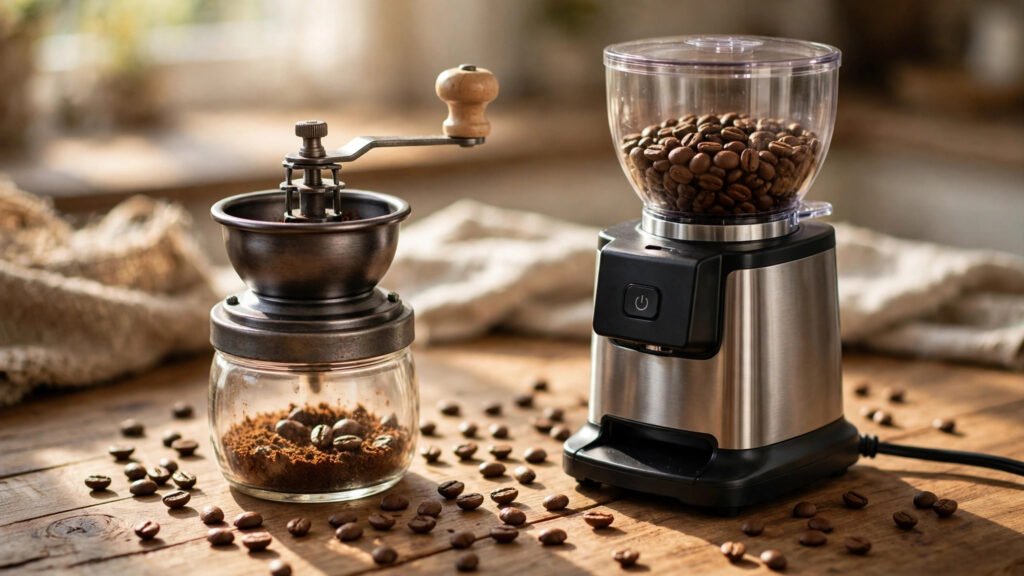
A manual grinder uses your hand. You turn a crank. The crank drives a burr set. Beans crush between the burrs. You control speed with your arm. Grinding one dose takes a minute or two. The work is quiet and steady.
An electric grinder uses a motor. You press a button or a switch. The motor drives the same kind of burr set. Grinding one dose takes seconds. The work is fast and loud. You trade effort for noise.
Both types use burrs in good models. Cheap models of both types can disappoint. A good hand grinder beats a poor electric one. A good electric grinder beats a poor hand one. Judge the burr set first, not the power source.
Grind Quality at the Same Budget
This is the key comparison. At the same budget, a manual grinder usually grinds better. The reason is simple. Your money goes into the burr set. An electric grinder spends part of your money on a motor. A manual grinder spends almost all of it on burrs.
That gap shows most at low budgets. A low-cost hand grinder can grind evenly for pour over. A low-cost electric grinder may wobble and make dust. At higher budgets, the gap shrinks. Good electrics grind as evenly as good hand grinders. They just cost more to reach the same quality.
| Factor | Manual grinder | Electric grinder |
|---|---|---|
| Grind quality per dollar | Higher — money goes to burrs | Lower — motor takes part of the budget |
| Evenness at low budget | Good for pour over and French press | Mixed — dust and fines are common |
| Evenness at high budget | Excellent across methods | Excellent across methods |
| Espresso ability | Good with a fine-adjustment model | Good with a stepless or fine-step model |
| Retention (old grounds left inside) | Near zero | Some, varies by model |
If your budget is tight, a hand grinder gives more quality. If your budget is generous, both types serve well. Pick on routine, not on quality alone.
Noise, Speed, and Effort
Noise favors the manual grinder clearly. Hand grinding is nearly silent. You hear a soft crunching sound. Electric grinding is loud. Motors whine and burrs buzz. Early morning grinding wakes light sleepers. A hand grinder solves that problem fully.
Speed favors the electric grinder clearly. It grinds a dose in seconds. A hand grinder takes a minute or two per dose. One cup is a small effort. Four cups in a row is real work. Large batches favor electric grinding strongly.
Effort favors the electric grinder too. You press a button and wait. A hand grinder needs arm work. That work is light for one dose. It grows tiring across many doses. People with wrist or arm trouble should choose electric. Comfort matters more than romance here.
Which One Suits Your Routine
Match the grinder to your daily pattern:
- Brew one or two cups daily: a hand grinder suits you well.
- Brew for a household each morning: an electric grinder saves real time.
- Rise early near sleeping family: a hand grinder keeps the peace.
- Brew espresso often: either type works if it adjusts finely enough.
- Travel or camp often: a hand grinder packs light and needs no power.
- Have wrist or arm trouble: an electric grinder is the kind choice.
Think about your worst morning, not your best one. A hand grinder feels fine on a slow weekend. It feels long on a rushed weekday with four cups to grind. An electric grinder feels loud on a quiet morning. It feels like a gift on a busy one.
When to Switch Types
Switch from hand to electric when volume grows. A new household member changes the math. A switch to batch brewing changes it too. If grinding feels like a chore, switch. Coffee should stay a pleasure, not a workout.
Switch from electric to hand when noise matters more. A new baby changes the math. A move to thin walls changes it too. If you brew one quiet cup daily, a hand grinder delights. Many coffee lovers own both in the end. They use electric on busy days and hand on slow ones.
For hand grinder picks, see our guide on best manual coffee grinders. For all grinder picks, see best coffee grinders.
Grind Settings on a Hand Grinder
Hand grinders adjust by clicks or by a dial. Clicks give repeatable steps. Dials give smooth, stepless control. Either system works well. Count your clicks from zero each time. Write the setting on the bag when you find it. That note saves you next time.
Start coarse and move finer slowly. Coarse grounds brew weak and sour cups. Fine grounds brew bitter and muddy cups. Move one click at a time. Taste after each change. Small steps teach you faster than big jumps. Keep a short note of grind, dose, and taste. Patterns show up fast once you can see them.
Common Questions
Is a hand grinder good enough for espresso?
Yes, if it adjusts finely enough. Espresso needs small, precise steps. Some hand grinders offer fine steps. Others jump too far per click. Check the adjustment system before you buy. A hand grinder built for espresso states it plainly.
How long does hand grinding take?
About one to two minutes per dose for most brewers. Espresso-fine grinding takes longer. Coarse French press grinding takes less. The time feels short for one cup. It feels long for four cups in a row.
Do electric grinders waste coffee?
Some do, a little. Grounds stay inside the chute and chamber. That leftover is called retention. Good designs keep it low. A quick purge before grinding helps. Hand grinders retain almost nothing by design.
The Short Answer
A manual grinder gives more grind quality per dollar and near silence. An electric grinder gives speed and ease. Tight budget or quiet mornings point to hand grinding. Big batches or busy mornings point to electric. Match the grinder to your routine. Either type grinds well when the burr set is good.