

There is nothing worse than anticipating a rich, velvety morning brew, only to take a sip and find it tastes like muddy water. If you are struggling with a bitter or weak cup, you are likely wondering exactly how much coffee for french press brewing is required to achieve perfection. Fortunately, mastering this balance is incredibly straightforward once you understand the core ratios.
Indeed, the secret to an extraordinary cup lies in the precise relationship between your coffee grounds and water. By establishing a consistent formula, you can eliminate the guesswork entirely. Consequently, your morning routine will transform from a game of chance into a reliable, delicious ritual.
Key Takeaways
- The Golden Ratio: A 1:15 water-to-coffee ratio is the ideal starting point for a balanced, full-bodied French press brew.
- Weight Over Volume: Measuring your ingredients in grams using a digital kitchen scale yields far more consistent results than using tablespoons.
- Grind Consistency: Always use a coarse, even grind to prevent over-extraction and avoid sediment in your cup.
- Water Temperature: Aim for water temperatures between 195°F and 205°F to extract the optimal flavor compounds.
The Science of the Golden Ratio
To understand why your coffee tastes the way it does, we must examine the concept of extraction. Specifically, extraction refers to the process where hot water dissolves the soluble compounds inside the coffee bean. However, if you use too much water, you will over-extract the grounds, resulting in a bitter taste.
Conversely, using too little water leads to under-extraction, which makes your beverage taste sour and weak. Therefore, coffee professionals rely on a specific ratio to maintain perfect harmony. For immersion brewing, a ratio of 1:15 is widely considered the absolute sweet spot.
This means that for every 1 gram of coffee, you should add 15 grams of water. Alternatively, if you prefer a slightly lighter and brighter cup, you can experiment with a 1:16 or 1:17 ratio. Ultimately, choosing the right ratio determines how much coffee for french press brewing will satisfy your personal palate.
Why Measuring How Much Coffee for French Press Matters
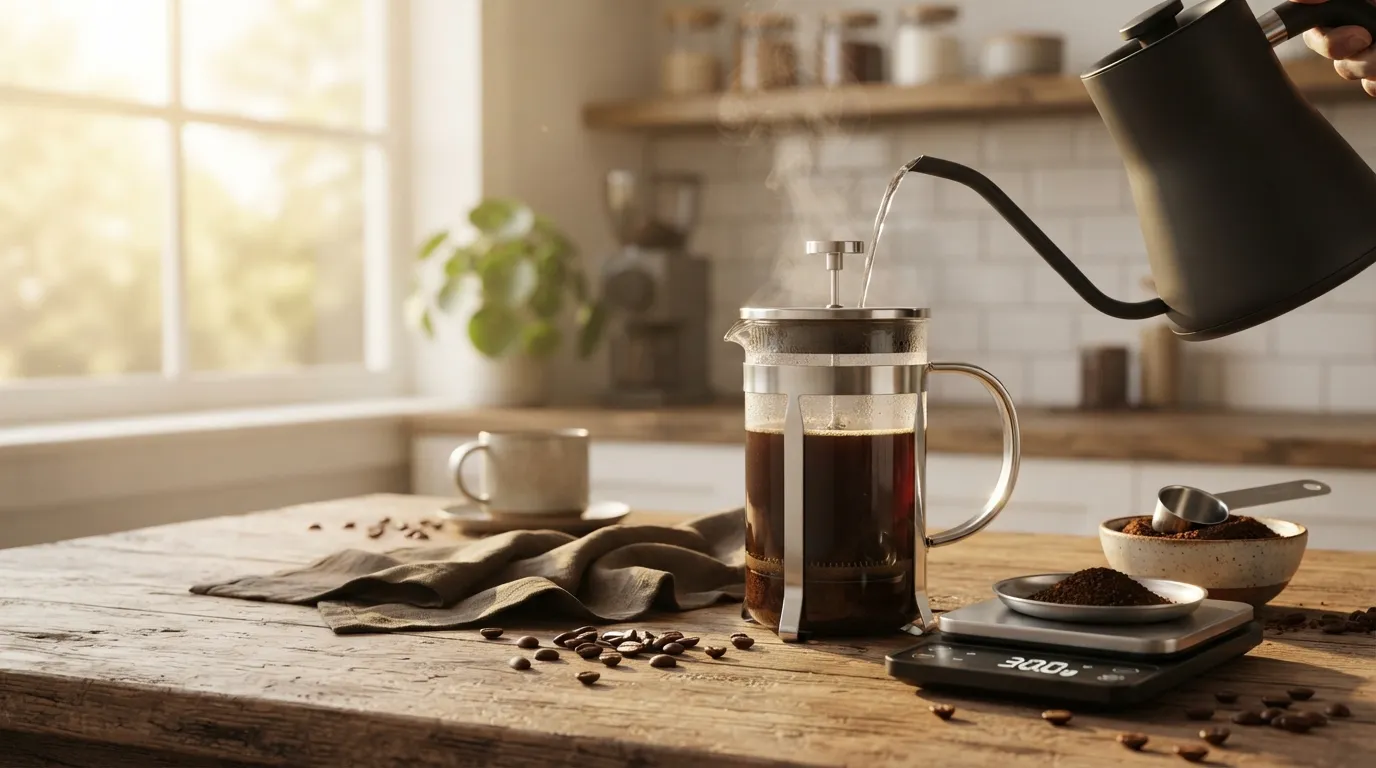
Many casual brewers prefer to scoop their coffee using a standard tablespoon. However, this method introduces a massive amount of variability into your daily routine. For instance, different coffee beans have vastly different densities depending on their roast profile and origin.
Specifically, dark roast beans are puffed up and larger, meaning they weigh less by volume than dense light roast beans. Consequently, two level tablespoons of a dark roast will weigh significantly less than two tablespoons of a light roast. Therefore, relying solely on volume measurements can lead to wildly inconsistent flavor profiles from week to week.
By shifting to a digital scale, you eliminate these frustrating discrepancies entirely. Furthermore, measuring by weight allows you to reproduce your favorite brews with scientific precision. As a result, you will quickly learn exactly how much coffee for french press pots of any size is necessary to achieve your desired strength.
The French Press Sizing Guide: Grams and Ounces
French press coffee makers are sold in various sizes, usually designated by “cups.” However, it is crucial to note that a standard coffee maker “cup” is only about 4 fluid ounces, not the typical 8-ounce cup used in cooking. Consequently, this discrepancy often causes confusion when calculating your water volume.
To simplify this process, we have broken down the precise measurements for the most common French press sizes below. By following these structured guidelines, you can easily determine how much coffee for french press carafes you need to fill.
The 3-Cup French Press (12 oz / 350 ml)
The small 3-cup French press is perfect for a single, generous mug of coffee. Specifically, it holds approximately 350 milliliters of water. To achieve a balanced 1:15 ratio, you will need to measure out exactly 23 grams of coffee beans.
If you do not own a digital scale, this equates to roughly 3 level tablespoons of coarse grounds. However, please remember that volumetric measurements are less precise. Therefore, we highly recommend investing in a scale to ensure your single-cup brew remains consistently delicious.
The 8-Cup French Press (34 oz / 1000 ml)
The 8-cup model is the most popular size found in kitchens worldwide. Because it holds 1 liter of water, it is ideal for serving two to three people. To maintain our golden ratio, you should use exactly 67 grams of coffee for this volume.
In terms of volume, this translates to approximately 8 to 9 tablespoons of coffee. Nevertheless, because of the larger volume, any small measurement error will be amplified. Thus, weighing your ingredients becomes even more critical when preparing this larger batch.
The 12-Cup French Press (51 oz / 1500 ml)
If you are hosting a brunch or brewing for a large family, the 12-cup French press is your best friend. This massive carafe holds 1.5 liters of water. Consequently, you will need a substantial amount of coffee to balance this large volume.
Specifically, we recommend measuring out 100 grams of coarsely ground coffee. If you must use tablespoons, you will need about 13 to 14 level tablespoons. However, using a scale remains the ultimate way to guarantee that your guests enjoy a premium, barista-quality beverage.
| Press Size (Cups) | Water Volume (ml / oz) | Coffee Weight (Grams) | Coffee Volume (Tablespoons) |
|---|---|---|---|
| 3-Cup | 350 ml / 12 oz | 23g | ~3 tbsp |
| 4-Cup | 500 ml / 17 oz | 33g | ~4.5 tbsp |
| 8-Cup | 1000 ml / 34 oz | 67g | ~9 tbsp |
| 12-Cup | 1500 ml / 51 oz | 100g | ~14 tbsp |
The Crucial Role of Grind Size
Once you determine how much coffee for french press brewing is required, you must focus on the grind. Indeed, the grind size is just as important as the ratio itself. Because the French press is an immersion brewing method, the coffee grounds sit in contact with hot water for several minutes.
Therefore, you must use a coarse grind that resembles sea salt. If your grind is too fine, the water will extract the bitter compounds too quickly. Furthermore, fine particles will easily slip through the metal mesh filter, leaving a thick layer of gritty silt at the bottom of your cup.
To achieve this coarse consistency, we strongly advise using a high-quality burr grinder rather than a blade grinder. This is because burr grinders crush the beans evenly, whereas blade grinders chop them into highly inconsistent sizes. Consequently, a uniform grind ensures a clean, beautifully extracted cup every single time.
Water Quality and Temperature
Since brewed coffee is over 98% water, the quality of your water directly impacts the final flavor. Specifically, using tap water containing chlorine or heavy minerals can ruin even the highest-quality specialty beans. Therefore, you should always use filtered or bottled spring water for the best results.
In addition, water temperature plays a vital role in extraction chemistry. If your water is boiling hot, it will scald the grounds and extract unpleasant, bitter flavors. Conversely, if your water is too cold, it will fail to extract the rich oils and aromatic compounds.
The ideal temperature range for brewing is between 195°F and 205°F. To achieve this without a thermometer, simply bring your kettle to a rolling boil, remove it from the heat source, and let it rest for 30 seconds before pouring. This simple pause allows the water to cool down to the perfect brewing temperature.
Step-by-Step French Press Brewing Guide
Now that you have mastered the measurements and grind size, it is time to put everything into practice. Follow this straightforward, reliable guide to brew a flawless pot of French press coffee every morning.
Step 1: Prep and Preheat
First, measure out your water and coffee beans according to your chosen ratio. While your water is heating up, pour a small amount of hot water into your empty French press carafe and swirl it around. This preheats the glass, preventing a sudden drop in temperature when you begin brewing.
Step 2: Add the Coffee Grounds
Next, discard the preheating water from the carafe. Add your coarsely ground coffee to the bottom of the empty press. If you are using a digital scale, place the entire French press onto the scale and tare it to zero so you can easily measure the water weight.
Step 3: The Bloom Phase
Gently pour just enough hot water over the dry grounds to thoroughly saturate them. Typically, this requires about double the weight of your coffee in water. Allow this mixture to sit undisturbed for 30 to 45 seconds.
During this phase, you will notice the coffee bubbling and expanding. This process, known as blooming, releases trapped carbon dioxide gas from the fresh beans. Consequently, removing this gas allows the remaining water to extract the delicious flavors much more efficiently.
Step 4: The Main Pour and Steep
After the bloom, slowly pour the remaining water into the carafe in a gentle, circular motion. Ensure that all the dry grounds are fully incorporated into the liquid. Next, place the lid on top of the press with the plunger pulled all the way up to trap the heat.
Now, set a timer for exactly four minutes. While the coffee steeps, the hot water will slowly pull the rich oils and flavor compounds from the coarse grounds. Do not rush this process, as patience is key to developing a deep, complex flavor profile.
Step 5: The Plunge and Serve
Once your four-minute timer sounds, it is time to complete the brew. Slowly and steadily press the plunger down. If you feel sudden resistance, back off slightly before continuing to press down gently.
Immediately after plunging, pour the freshly brewed coffee into your mug or a separate serving carafe. If you leave the liquid sitting in the French press with the grounds, it will continue to extract. Consequently, this will cause the remaining coffee to become bitter and over-extracted over time.
Troubleshooting Your French Press Brew
Even with precise measurements, you may occasionally run into flavor issues. Fortunately, understanding how to diagnose these common problems will help you refine your technique. Here is how to fix a brew that does not taste quite right.
If the Coffee Is Too Weak
If your beverage tastes watery or lacks body, you may have used too much water. To remedy this, try adjusting your ratio slightly. For instance, if you used a 1:16 ratio, try dropping down to a stronger 1:14 ratio next time.
Alternatively, your grind size might be too coarse, preventing the water from extracting enough flavor in four minutes. In this scenario, try grinding your beans slightly finer. However, ensure that the grind remains coarse enough to be caught by the metal filter.
If the Coffee Is Too Bitter
Conversely, if your coffee has an unpleasant, harsh bitterness, over-extraction is the likely culprit. To resolve this, ensure you are not leaving the brewed coffee in the press after plunging. Furthermore, check your water temperature to make sure it was not boiling hot when you poured it.
In addition, you can try increasing your grind size slightly to slow down the extraction process. Finally, check your ratio to ensure you did not accidentally use too little coffee. Adjusting these small variables will quickly bring your brew back into perfect balance.
Related Coffee Topics You May Like
Frequently Asked Questions
How many tablespoons of coffee do I need for a standard 8-cup French press?
For a standard 8-cup French press, which holds 1 liter of water, you will need approximately 8 to 9 tablespoons of coarse coffee grounds. However, using tablespoons is less precise than using a scale. Therefore, we highly recommend weighing out 67 grams of coffee to ensure you know exactly how much coffee for french press brewing is required for a consistently balanced cup.
What is the best water-to-coffee ratio for a French press?
The universally accepted “Golden Ratio” for French press brewing is 1:15. This means you should use 1 gram of coffee for every 15 grams of water. If you prefer a slightly lighter or less intense flavor, you can easily adjust this ratio to 1:16 or 1:17 based on your personal taste preferences.
Can I use pre-ground coffee in a French press?
While you can use pre-ground coffee, it is generally not recommended because most pre-ground coffee is designed for drip machines and is ground too fine. Fine coffee grounds will easily pass through the French press mesh filter, resulting in a gritty, muddy texture. Furthermore, pre-ground coffee loses its freshness and aromatic oils very quickly.
How long should I let my French press coffee steep?
The ideal steeping time for a French press is exactly four minutes. This allows the hot water sufficient time to extract the rich flavors and oils from the coarse grounds. If you plunge too early, your coffee will be thin and under-extracted; if you wait too long, it will become bitter and over-extracted.
Ready to Elevate Your Morning Coffee?
Stop guessing and start brewing like a professional. Grab our premium digital kitchen scale and fresh-roasted coffee beans today to achieve the perfect golden ratio in every single cup!